Showing posts with label saint paul. Show all posts

Friday, May 09, 2008

Badiou's Saint Paul; Chapter 9

After exploring the relationship between faith and love Badiou looks at Paul's concept of hope. He first frames a classic notion as hope in the Final Judgment and then says,


Against this classic judicial eschatology, Paul seems instead to characterize hope as a simple imperative of continuation, a principle if tenacity of obstinacy. In Thessalonians I, faith is compared to a striving, and love to grueling work, to the laborious, the troublesome. Hope, for its part, pertains to endurance, to perseverance, to patience; it is the subjectivity proper to the continuation of the subjective process.

And so Badiou claims for hope a subjective victory that cannot accept an objective doctrine of judgment and division of the 'evildoers' for this would dislodge the universal affirmation of love. "The One is inaccessible without the 'for all'." Hope is that which sustains the present work within this universality and so is no longer future orientated but is a present reality which "does not disappoint." (Rom 5:2)

Read More...

Thursday, May 08, 2008

I Bid You Badiou - Chapter 8; All You Need is Love

Previously,
Badiou's Saint Paul Chapter 1
Badiou's Saint Paul Chapter 2
Badiou's Saint Paul - Chapters 3-4
Badiou's Saint Paul - Chapter 5
Badiou's Saint Paul - Chapter 6
Badiou's Saint Paul - Chapter 7

For Paul obedience to the law cannot justify the exist of the subject and yet overthrows the possible dialectic between law and grace by saying that the law is holy and that the law is spiritual.

For Badiou this points to 'transliteral law'. This is what emerges from the grace of the event. It is a universal law that is all for all people, it is love. This love exists in declaration, it is militant. It is worth quoting Badiou here in full,


The real of faith is an effective declaration, which, with the word 'resurrection,' utters that life and death are not ineluctably distributed as they are in the 'old man.' Faith publicly acknowledges that the subjective apparatus commanded by the law is not the only possible one. But it become apparent that faith, confessing resurrection in one man, merely declares a possibility for everyone. That a new assemblage of life and death is possible is borne out by resurrection, and this is what must first be declared. But this conviction leaves the universalization of the 'new man' in suspense and says nothing as to the content of the reconciliation between living thought and action. Faith says: We can escape powerlessness and rediscover that from which the law separated us. Faith prescribes a new possibility, one that, although real in Christ, is not, as yet, in effect for everyone.
It is incumbent on love to become law so that the truth's postevental universality can continuously inscribe itself in the world, rally subjects to the path of life. Faith is the declared thought of a possible power of thought. It is not yet this power as such. As Paul forcefully puts it, "faith works only through love."

Love is no prohibition but pure affirmation. And truth is faith working through love.

Read More...

Wednesday, April 30, 2008

I Bid You Badiou - Chapter 7; Paul Against the Law . . . Again

Previously,
Badiou's Saint Paul Chapter 1
Badiou's Saint Paul Chapter 2
Badiou's Saint Paul - Chapters 3-4
Badiou's Saint Paul - Chapter 5
Badiou's Saint Paul - Chapter 6

In chapter 7 of Saint Paul Badiou attempts to slain the giant by approaching the theological quicksand of Paul's understanding of faith vs. works / grace vs. law. There is such enormity of thought and history connected to this discussion that I was not sure much room could be spared for additions.

And after reading over the chapter again I am not sure that much was added. The question initially was why law should be placed on the side of death. The answer is simply is that law 'objectifies' salvation disallowing the unity of thought and action. Not only is law always relegated to the particular and so cannot be part of the universal it also determines the subject in a cycle of the 'automatic repetition' of sin. Here Badiou deals extensively with Romans 7.


The law is what gives life to desire. But in so doing, it constrains the subject so that he wants to follow only the path of death.
What is sin exactly? It is not desire as such, for if it were one would not understand its link to the law and death. Sin is the life of desire as autonomy, as automatism. The law is required in order to unleash the automatic life of desire, the automatism of repetition. For only the law fixes the object of desire, binding desire to it regardless of the subject's 'will.' It is this objectal automatism of desire, inconceivable without the law, that assigns the subject to the carnal path of death.
Clearly, what is at issue here is nothing less that the problem of the unconscious (Paul calls it the involuntary, what I do not want). The life of desire fixed and unleashed by the law is that which, de-centered from the subject, accomplishes itself as unconscious automatism, with respect to which the involuntary subject is capable only of inventing death.
The law is what, designating its object, delivers desire to its repetitive autonomy.

This emergence of sin is, in keeping with his thinking, a subjective disposition. But as a sinful subjectification it is de-centers the subject dividing thought from action (what I want to do I do not do). In light of this Badiou states that salvation is possibility of thought being unseparated from power and action. Thought, in itself, cannot overcome this division. What is required is a grace that exceeds the order of thought. Grace flows from the event of the resurrection which declares that life need not be bound by death.

Read More...

Tuesday, April 29, 2008

I Bid You Badiou - Chapter 6; The Site of Death / The Event of Life


Chapter 6 is for me one of the more difficult chapters to understand in this book. I think this difficulty in understanding comes from the conceptual content being both foreign and also heretical (from the perspective of historical orthodoxy). I was constantly trying to negotiate within myself whether or not I was actually understanding the content and if I was understanding it whether or not I could accept it. I found this in itself an interesting exercise in learning and reading.

This chapter deals with the role of death as it relates to the resurrection of Christ. Badiou begins by framing the chapter with the question of whether Paul is morbid as Nietzsche has characterized him; or in the more Hegelian framework whether death functions in dialectic of truth (I am woefully ignorant of Hegel to articulate this any further). Badiou maintains that if resurrection is caught up in this dialectic then the possibility of grace "is dissolved into an auto-foundational and necessarily deployed rational protocol." Grace rather is an "affirmation without preliminary negation." I can pick up Badiou's strand of thinking later in the chapter but here I lose him. He continues,


This de-dialectization of the Christ-event allows us to extract a formal, wholly secularized conception of grace from the mythological core. Everything hinges on knowing whether an ordinary existence, breaking with time's cruel routine, encounters the material chance of serving a truth, thereby becoming, through subjective devision and beyond animal's survival imperatives, an immortal.

What Badiou seems to be developing, and perhaps this is where my orthodoxy gets in the way of understanding, is the radical possibility of living truth apart from the apparatus of religious law or intellectual foundation. Badiou,

Let us posit that that it is incumbent upon us to found a materialism of grace through the strong, simple idea that every existence can one be seized by what happens to it and subsequently devote itself to that which is valid for all, or as Paul magnificently puts it, "become all things to all men."
Yes, we are the beneficiaries of certain graces, ones for which there is no need to invoke an All-Powerful.

I will set that final statement aside for now. From here Badiou articulates the non-dialectical nature of resurrection and how then death functions in relationship to it. Paul is not viewed as having a theology of suffering as such. Suffering is certainly to be expected but that is only because of living apart from the dominant discourses of wisdom and law. This changes how we understand the cross. For Paul then there is no "path of the Cross. There is Calvary, but no ascent to Calvary." This appears to be entering into another discourse that allows the play of competition and mastery. Elevation and status through suffering.
This leads us finally to Badiou's statement on death. In Paul death is placed on the side of flesh and law (subjectively conceived and not biologically or platonically) and therefore can have no sacred or spiritual function. Whereas death was the invention of man (Adam) Christ (the second Adam) comes to reveal the human possibility of life. Badiou makes a very important move here. With the death of the fully human Jesus God enters into complete filiation with humanity.

Such is the unique necessity of Christ's death: it is the means to an equality with God himself. Through this thought of the flesh, whose real is death, is dispensed to us in grace the fact of being in the same element as God himself. Death here names the renunciation of transcendence. Let us say that Christ's death sets up an immenentization of the spirit. [emphasis his]

The transcendent space between God and humanity exists only so long as the law occupies the mediating gulf. With death the gulf is collapses and establishes the site of the resurrection. This is the event of reconciliation though not of salvation. Resurrection (salvation) is that which emerges from the site. However Badiou again makes it clear,

Resurrection is neither a sublation, nor an overcoming of death. They are two distinct functions, whose articulation contains no necessity. For the event's sudden emergence never follows from the existence of an evental site. Although it requires conditions of immanence, that sudden emergence nevertheless remains of the order of grace.

Resurrection and life must not be contingent on the discourses of mastery which is the subjective of law and of death even though life emerges from the site of death. The language is not always clear to me in this area for we are not to speak of an 'overcoming' of death though on the same page Badiou speaks of a 'killing' of death. What is important is the universal 'yes' be maintained.
Here Badiou again brings this thinking into relationship with Nietzsche as sibling not opponent. Both are interested in introducing a 'new' man unfettered from law.

The truth is that both brought antiphilosophy to the point where it no longer consists in a 'critique,' however radical, of the whims and pettiness of the metaphysician or sage. A much more serious matter is at issue: that of bringing about through the event an unqualified affirmation of life against the reign of death and the negative. Of being he who, Paul or Zarathustra, anticipates with flinching the moment when 'death is engulfed in victory.' (1 Cor 15:24)

Christ comes out of death and does not remain contingent to it. There remains then not the dialectic of death and life but the subjective choice of death and life.
Badiou concludes the chapter by confusing (offending?) me in even further. In trying to understand why this event offer as universal ability to suspend differences Badiou instructs us that, "it is essential to remember that for Paul, Christ is not identical with God, that no Trinitarian or substantialist theology upholds his preaching." This conceptual framework must be divorced from the metaphor of "the sending of the son." In this way the infinite does not die on the cross. It is important for Badiou that "terminating the abyss of transcendence, be immanent to the path of the flesh, of death, to all the dimensions of the human subject." That Christ must be entirely and solely human. And so Badiou arrives at the statement, "Paul's thought dissolves incarnation in resurrection."
I cannot for the life of me follow all his thinking here. It appears important that it not be the 'infinite' that dies but that it is a fully human expression. That it is the human who invents death and also that it is the human that experiences and expresses the possibility of the infinite through the immanentization of the spirit. This should of course be obvious for Badiou from the outset appropriates this as the secular reality/possibility of the event. Does this disqualify it outright for the orthodox believer? We'll keep plugging along for now.

Read More...

Thursday, April 24, 2008

I Bid You Badiou - Chapter 5; A Paul Divided

Previously,
Badiou's Saint Paul Chapter 1
Badiou's Saint Paul Chapter 2
Badiou's Saint Paul - Chapters 3-4; Earthen Vessels \ Carrying Death

Badiou begins chapter 5 by stating that the subjectivity expressed by Paul is a divided subjectivity which is between flesh and spirit. Badiou emphasizes that this is a subjective division and not a platonic division between soul and body but of a division within thought. This division allows for a new object of discourse.

For the Greek the object of discourse is finite cosmic totality. This is a discourse of place, of knowing belonging. Christian discourse attests to the vanity of places. Badiou cites Paul's acknowledgment of being the 'refuse' of the world.
For the Jew the object is elective belonging. The mark of this belonging is manifest in the observance of the law. In Christian discourse the Christ-event comes as pure excess, "grace without concept or appropriate rite."
This is leads to the abolition of the local, undivided subject who is defined by race, origin, locality, ritual, etc. In order to maintain this understanding Paul must advocate a true antiphilosophy unlike that of Wittgenstein, Nietzsche and Pascal who continued to concern with "knowledge." Paul's work does not attempt to heal wisdom and it does not attempt to critique it. It is for Paul obsolete in so far as wisdom falls under the "formula of mastery." Paul rejects both the modes of sign (Jew) and wisdom (Greek) as both enforces modes of mastery. Paul is not interested in overcoming these discourses he simply does not enter into them.
Badiou addresses Paul's understanding of Jesus as 'son' as further indication of how the subject is founded apart from the discourses of mastery. We are able to identify ourselves as offspring but we are never able to identify with the singular Father. This a universal egalitarian perspective (We are all God's coworkers 1 Cor 3:9).
In order to maintain this perspective Paul strips Jesus of any significance historically. In this way Jesus is "neither a master nor an example. He is the name for what happens to us universally." Here Badiou offers an interesting comparison between Nietzsche and Paul. Nietzsche is of course highly critical of Paul but Badiou argues that this intense response to Paul is because "he is his rival far more than his opponent." Both figures desire for substantial shift in the individual's subjectivity. Badiou argues that Nietzsche relies on three themes of which Paul is the founder. 1) the self-legitimating subjective declaration; 2) the breaking of history in two; 3) the new man as the end of guilty slavery and affirmation of life. The problem with Nietzsche is that he attempted to maintain that Paul's motif was death when it was just the opposite. In Paul "life takes revenge on death." What Nietzsche was genuinely and correctly opposed to was Paul's universal. Paul offered an absolute and unrelenting all which abolished the status and privilege attained by the strong.
Paul advocates a subjectivity founded on grace. This subjectivity is a becoming and not a state. It must always function in relationship to the "not - but," for you are not under law, but under grace. The not always functions to shut down and dismantle the discourses of mastery and the but seeks to open paths of faithful work towards a universal communion.

Read More...

Wednesday, April 23, 2008

I Bid You Badiou - Chapters 3-4; Earthen Vessels \ Carrying Death


I realize that I am essentially working chapter by chapter in Saint Paul so for earlier references see;
Badiou's Saint Paul Chapter 1
Badiou's Saint Paul Chapter 2

Chapter three of Saint Paul addresses the context into which Paul's letters were written; that they were substantially prior than the writing of the gospels, that they were substantially different than the gospels, and how they came to be recognized as canonical.
In chapter four Badiou expands his account of Paul's two main referents, Jews and Greeks. What he sees Paul addressing is not two ethnic groups but two subjectivities or discourses (law and wisdom). Rather than adopting or adapting these discourses Paul initiates two other discourses. It is the third discourse that is the 'Christian' discourse properly speaking while the fourth (mystical) remains at the margins.
Badiou begins by explaining the Jewish and Greek discourses.


What is Jewish discourse? The subjective figure constituted by it is that of the prophet. But a prophet is one who abides in the requisition of signs, one who signals, testifying to transcendence by exposing the obscure to its deciphering. Thus, Jewish discourse will be held to be, above all, the discourse of the sign.
What then is Greek discourse? The subjective figure constituted by it is that of the wise man. But wisdom consists in appropriating the fixed order of the world, in matching of the logos of being. Greek discourse is cosmic, deploying the subject within the reason of natural totality. Greek discourse is essentially the discourse of totality, insofar as it upholds sophia (wisdom as internal state) of a knowledge of phusis (nature as ordered and accomplished deployment of being).

Badiou continues by saying that "Paul's profound idea is that Jewish dicourse and Greek discourse are the two aspects of the same figure of mastery." These divisive subjectivities at once dependent on and in conflict with each other not allowing for a universal presence. In order to proceed from this conflict an event is required which is "a-cosmic and illegal."

One may also say: Greek and Jewish discourse are both discourses of the Father. That is why they bind communities in a form of obedience (to the Cosmos, the Empire, God, or the Law). Only that which will present itself as a discourse of the Son has the potential to be universal, detached from every particularism. . . . That the son, and not the father, who is exemplary, enjoins us not to put our trust any longer is any discourse laying claim to the form of mastery.

For Badiou then Paul offers himself as neither prophet nor philosopher but apostle. And an apostle is one who is faithful to the even of the resurrection and who names the possibilities that this rupture implies. In this way Paul strictly speaking "knows nothing" (here Badiou cites 1 Cor 8:2). Focusing on Paul's words in 1 Corinthians Badiou sees the criteria for recognizing the event as that which puts language in deadlock. As such it is folly to the Greeks and a scandal to the Jews. Paul is understood to go so far as saying that God is not Being as being exists in the realm of these prior discourses. Badiou points to subversive statement in 1 Corinthians which says, "God has chosen the things that are not in order to bring to nought those that are." These is the abolition of all previous discourses. This is "pure beginning." There is no proof and no knowledge. This becomes the inherent 'weakness' in Christian discourse.
Badiou briefly outlines the 'fourth' discourse which the nondiscourse of mystical experience. This is significant for Paul but never a means for legitimation. The universal discourse must rather be a shared discourse of the event. In this way the 'weakness' of Christian discourse will not be relived through any 'hidden' force. To grant the fourth discourse primacy of place is to replace into the Jewish discourse of the sign. And so the fourth discourse will remain but marginal and essentially inactive in any public sense. Badiou understands the weakness of the third discourse to be what Paul refers to as the treasures in earthen vessels. Badiou concludes the chapter with some sense grandeur over this weakness,

The treasure is nothing but the event as such, which is to say a completely precarious having-taken-place. It must be borne in humbly, with a precariousness appropriate to it. The third discourse must be accomplished in weakness, for therein lies its strength. It shall be neither logos, nor sign, nor ravishment by the unutterable. It shall have the rude harshness of public action, of naked declaration, without apparel other than that of its real content. There will be nothing but what each can see and hear. This is the earthen vessel.
Whoever is the subject of a truth (of love, of art, or science, or politics) knows that, in effect, he bears a treasure, that he is traversed by an infinite power. Whether it not this is truth, of precarious, continues to deploy itself depends solely on his subjective weakness. Thus, one may justifiably say that he bears it only in an earthen vessel, day after day enduring the imperative - delicacy and subtle thought - to ensure nothing shatters it. For with the vessel, and with dissipation into smoke of the treasure it contains, it is he, the subject, the anonymous bearer, the herald, who is equally shattered.

Read More...

Tuesday, April 22, 2008

I Bid You Badiou - Part II

Badiou understands Paul as someone who has become. His subjectivity flows entirely from encounter with the resurrected Jesus. There was no lead up, it simply ruptured his present existence and created someone new and without precedent in him. It is Christ resurrected that legitimates his existence, subjectivity and message (Paul does not seek immediate confirmation for the emerging church leaders in Jerusalem). This message leads to Paul found small critical masses of 'comrades' who express faithfulness to the resurrected Christ (they repent and believe). It is from these small and early communal formations that we see Paul as social organizers as his epistles come from the need for maintenance within these groups.
In (short) time Paul's message creates conflict with both Jews and Greeks. Among the Jews there is pressure to legitimate this message within the contingencies of their religion, primarily in circumcision and food laws. It must be stated clearly that in response to the law Paul is not in opposition what matters is adherence to the truth of the event. Following the law is nothing and not following that law is nothing (circumcision in nothing, uncircumcision is nothing, 1 Cor 7:19). This conflict leads to the Jerusalem council where a compromise is brokered that maintains the value of recognizing the historical site Jesus' resurrection (Jewish-Christianity) as well as acknowledging an openness to alternative expressions of faithfulness to the message (Paul's gospel). The conflict should not be underestimated as it erupts again when Paul confronts Peter's duplicity in matters of custom (Peter is breaking Jewish law until he sees James at which time he attempts to reconform to the customs, Gal 2). Badiou sees this experience as decisive in the formation of Paul's message which in large part "is that the law has become a figure of death." There is no more negotiating between law and Christ. Here lies Paul's decisive break with the conditioned expression of Jewish religion, even as it recognizes Jesus as the Messiah.
Badiou then turns his attention to Paul's encounter with the Greeks. Though will to enter conversation Paul offers no sustained critique after the philosophers in Athens burst out laughing at the mention of the resurrection. In his letter to the Corinthians Paul is even more clear that he has no intention in meeting human wisdom with wisdom. This would assume that the event of Christ could come the legitimation of a controlling body of knowledge or natural order.
And so we encounter Paul's two primary referents Jews (law) and Greeks (wisdom). What follows is Badiou's account of how Paul attempts to maintain a social expression that will not fall under controlling paradigm of either.

Okay, time for bed . . . stay tuned.

Read More...

I Bid You Badiou - Part I

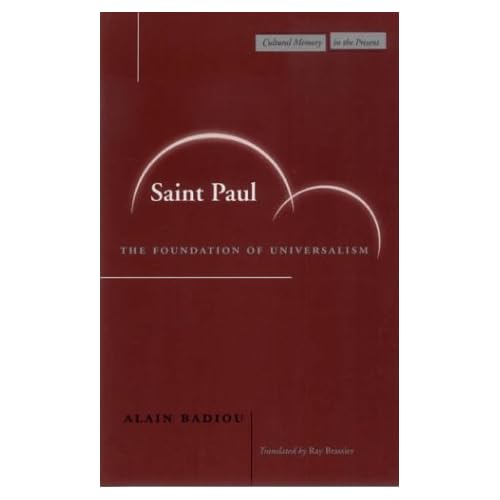
This Sunday I will be preaching on Acts 17, the well known passage of Paul's encounter with the philosophers in Athens. In preparation I thought I would finally read Badiou's book on Saint Paul and see how Paul faired with this philosopher. Badiou has been receiving fairly good press among many theologians and biblical scholars. There is certainly significant insight gleaned throughout. Badiou states in the Prologue that he cares "nothing for the Good News he declares." But then comes the statement that sets the tone for the entire work, "But he is subjective figure of primary importance." Badiou is looking to configure a contemporary subject from the example of Saint Paul; or to use his own words, "to refound a theory of the Subject that subordinates its existence to the aleatory dimension of the event as well as to the pure contingency of multiple-being without sacrificing the theme of freedom." For Paul the entirety of his project consists in the statement "Christ is resurrected". It is this event that allows Paul to level or demolish all communitarian difference. Identity and law become founded in an event that while have a historical site is founded on no historical or cultural narrative. It is owned by no people but is for all people. It is universal.
Badiou summarizes Paul's procedure;


if there has been an event, and if truth consists in declaring it and then in being faithful to ti this declaration, two consequences ensue. First, since truth is evental, or of the order of what occurs, it is singular. It is neither structural, nor axiomatic, nor legal. No available generality can account for it, nor structure the subject who claims to follow in its wake. Consequently, there can be a law of truth. Second, truth being inscribed on the basis of a declaration that is in essence subjective, no preconstituted subset can support it; nothing communitarian or historically established can lend its substance to the process of truth. Truth is diagonal relative to every communitarian subset; it neither claims authority from, nor (this is obviously the most delicate point) constitutes any identity. It is offered to all, or addressed to everyone, without a condition of belonging being able to limit this offer, or this address.

This leads Badiou to offer four maxims of the truth as universal singularity as it applies to Paul and to our contemporary context.
1. The Subject does not preexist the event and thus the extrinsic conditions of his existence or identity will be argued against (i.e. neither Jew nor Greek, slave nor free, male nor female).
2. Truth is entirely subjective and therefore under no law.
3. Fidelity to the declaration is essential, for truth is a process, and not an illumination. This process requires the presence of faith (or conviction) at the point of declaration, love as its militant address and hope (or certainty) as the force understanding the completion of the truth.
4. A truth is of itself indifferent to the state of the situation. This requires a distance for the State and from what corresponds to the State in people's consciousness: the apparatus of opinion. One must not argue about opinions, Paul says.

Okay I should actually get to work now, more later.

Read More...