Tuesday, April 22, 2008

I Bid You Badiou - Part I

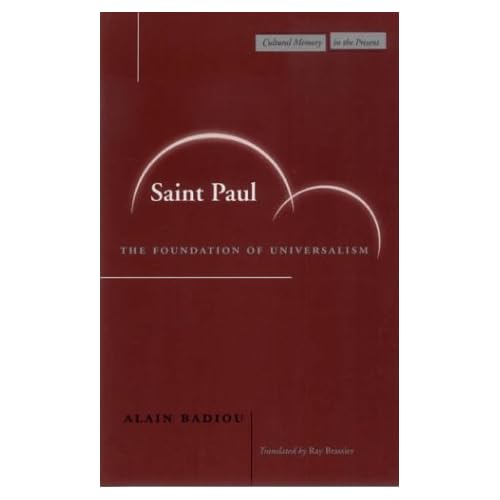
This Sunday I will be preaching on Acts 17, the well known passage of Paul's encounter with the philosophers in Athens. In preparation I thought I would finally read Badiou's book on Saint Paul and see how Paul faired with this philosopher. Badiou has been receiving fairly good press among many theologians and biblical scholars. There is certainly significant insight gleaned throughout. Badiou states in the Prologue that he cares "nothing for the Good News he declares." But then comes the statement that sets the tone for the entire work, "But he is subjective figure of primary importance." Badiou is looking to configure a contemporary subject from the example of Saint Paul; or to use his own words, "to refound a theory of the Subject that subordinates its existence to the aleatory dimension of the event as well as to the pure contingency of multiple-being without sacrificing the theme of freedom." For Paul the entirety of his project consists in the statement "Christ is resurrected". It is this event that allows Paul to level or demolish all communitarian difference. Identity and law become founded in an event that while have a historical site is founded on no historical or cultural narrative. It is owned by no people but is for all people. It is universal.
Badiou summarizes Paul's procedure;


if there has been an event, and if truth consists in declaring it and then in being faithful to ti this declaration, two consequences ensue. First, since truth is evental, or of the order of what occurs, it is singular. It is neither structural, nor axiomatic, nor legal. No available generality can account for it, nor structure the subject who claims to follow in its wake. Consequently, there can be a law of truth. Second, truth being inscribed on the basis of a declaration that is in essence subjective, no preconstituted subset can support it; nothing communitarian or historically established can lend its substance to the process of truth. Truth is diagonal relative to every communitarian subset; it neither claims authority from, nor (this is obviously the most delicate point) constitutes any identity. It is offered to all, or addressed to everyone, without a condition of belonging being able to limit this offer, or this address.

This leads Badiou to offer four maxims of the truth as universal singularity as it applies to Paul and to our contemporary context.
1. The Subject does not preexist the event and thus the extrinsic conditions of his existence or identity will be argued against (i.e. neither Jew nor Greek, slave nor free, male nor female).
2. Truth is entirely subjective and therefore under no law.
3. Fidelity to the declaration is essential, for truth is a process, and not an illumination. This process requires the presence of faith (or conviction) at the point of declaration, love as its militant address and hope (or certainty) as the force understanding the completion of the truth.
4. A truth is of itself indifferent to the state of the situation. This requires a distance for the State and from what corresponds to the State in people's consciousness: the apparatus of opinion. One must not argue about opinions, Paul says.

Okay I should actually get to work now, more later.

Read More...

Monday, April 21, 2008

Out and About

See I Cite for a great and horrible list. The Valve explores the Bible as literature (not).

Read More...

Sunday, April 20, 2008

In as much as you are able . . .

In as much as you are able the next time you pass a child and make eye contact offer them a sincere smile. They will encounter enough already that tells them that the world can scary, chaotic or threatening. They may even encounter enough that tells them that they are the center of meaning and that they deserve to have what they want. They will surely encounter message of expectation and demand, shame and failure. But of simply spacious kindness there remains limited resources.

Read More...

Friday, April 18, 2008

Theology and Gendered Ministry: A Critique of (Some) Contemporary Men's Ministries

Previously in this series;
Preface to Theology and Gendered Ministry
Framing Gender Differences
Understanding the Gendered Jesus - Part 1; Graham Ward's Cities of God
Understanding the Gendered Jesus - Part 2; Graham Ward's Christ and Culture

Given the preceding discussion on gender (see above links) it is important to ask the question of what is implicitly involved in men’s ministry, particularly in North America. The general history of gender in the modern West appears to be the movement of women from an inferior form of male to a distinct and ‘opposite’ sex (though still inferior). Then came a growing movement among women attempting to establish themselves as fully equal humans able to participate in all of life to the extant that particular individuals are able. This led to a crisis within masculinity as men were forced to redefine their own identities or to reject emerging feminist identities. It is important to ask why this led to a crisis among men.[1] I would suggest that the crisis among men relates directly to power dynamics inherent within any social system. Whether within a family or in a society an internal shift always creates pushes and pulls within the whole system. The reactions to change often expose those who are poorly self-differentiated, those whose own life was dependent on the stability or subordination of another.[2] In social terms this can be set more clearly in terms of power and law. In The History of Sexuality Foucault explores the “‘analytics’ of power: that is, . . . the specific domain formed by power relations.”[3] Dealing particularly with sexuality Foucault states that power is always established in relation sex in a negative expression, one of “rejection, exclusion, refusal, blockage, concealment or mask.”[4] This leads to his next statement which is that “sex is placed by power into a binary system: licit and illicit, permitted and forbidden.”[5] Which is further developed into a “cycle of prohibition” and “the logic censorship” which relegate aspects of sex into non-existence. Once caught into this framework the cycle is self-perpetuating and self-justifying. “One must not talk about what is forbidden until it is annulled in reality; what is inexistent has no right to show itself, even in the order of speech where its inexistence is declared; and that which one must keep silent about is banished from reality as the thing that is tabooed above all else.”[6] The stability of the dominant system depends on the ‘inexistence’ of that which is under its power.

It is important to remember that the first statement on the domain of power and sex is its negative relationship. It is confusing that such extreme outcry has emerged from particular men and men’s group as to the apparent ‘feminization’ of the church. Though the vast majority of church leadership is male and church attendance is divided roughly 60 percent female and 40 percent male writers such as Leon Podles mourn the loss of the masculine church which he says men lost already in medieval period.[7] Were the ratio of leaders reversed feminists would be celebrating in the streets. I do not discount that as an institution the church is far more open to feminine expressions in comparison to other social institutions in the West. What I am interested in is the type of response this can engender in men. In family systems a well-differentiated individual is able to accept, even welcome growth and increased independence of an individual within the family. This is not the type of response typically encountered by men writing on this issue. Rather, what is being revealed is the power-relations that had been implicit in the church structure prior to these shifts. Podles assumes that the church and God were once explicitly masculine. Historically women in the church, as in biology, were relegated under the larger masculine hierarchy (Podles argues that masculinity itself, ‘that which separates,’ is analogous to holiness). This relationship follows the structure of power relations that Foucault describes. As women became ‘existent’ and emerged from outside the power structure the structure appeared to be destabilized but had no ‘positive’ response. On this subject Ward writes that “the reality of women calls into question the governing male ontology, the hierarchal ontology, which supports . . . exploitation.”[8] The only response was a renewed attempt to relegate women back into constraint and render them ‘annulled in reality.’ This type of response only seems to confirm that much of the church had functioned under an unequal power structure that did allow the creative tension of sexual difference as Ward outlined above. In Podles’ ecclesial construct feminization is a threat as opposed to a complementary or even necessary expression of the church. Podles writes that “Christianity is [now] a religion of and for women.”[9] And if this is wrong, as it is in his account, then the response is to restructure a church that is of and for men as opposed to a church that embraces male and female as divine expressions of being human. This is a negative power relationship. The only ‘positive’ content that tends to emerge from specific male ministries is the need for men to gather and express themselves in complete exclusion to women. What is ironic is that even this expression requires women otherwise there would be no framework for ‘separating,’ which is key in Podles understanding of masculinity (and even more ironically, key for Ward’s notion of sexual difference and ‘space’).

Understanding the contemporary context of men and the church aids pastoral care givers in their ability to discern the larger web of issues that may be implicitly or explicitly informing a particular situation. The questions that need to be asked include the following. To what extant should particular ‘male’ expressions be endorsed and what expressions need to be brought into greater relationship with feminine difference and space? What are issues for men as men and what are issues for men as humans in a particular social position? It is only after understanding the theology of gender relations that these can questions can be answered appropriately as a pastor.


[1] It should that other factors, such as economics, can also be attributed to the shift in masculinities in the West. See R. W. Connell, “The History of Masculinity,” in The Masculinity Studies Reader.

[2] With reference to family systems see Edwin H. Friedman, Generation to Generation: Family Process in Church and Synagogue (New York: The Guilford Press, 1985).

[3] Michel Foucault, The History of Sexuality, vol. 1, An Introduction, trans. Robert Hurley (New York: Vintage Books, 1978), 82.

[4] Ibid., 83.

[5] Ibid.

[6] Ibid., 84.

[7] Originally published Leon Podles, “Missing Fathers of the Church: The Feminization of the Church and the Need for Christian Fatherhood,” Touchstone 14.1 (Jan/Feb 2001). Retrieved April 2, 2008 from http://www.touchstonemag.com/docs/issues/14.1docs/14-1pg26.html. This article updates and applies is early work The Church Impotent: The Feminization of Christianity (Dallas, TX: Spence Publishing Company, 1999).

[8] Ward, Christ and Culture, 138.

[9] Podles, “Missing Fathers.”

Read More...

Thursday, April 17, 2008

Archiving and Print Friendly Blogs

Just below the IndieVision widget to the right is a new Print It button. This is a new widget by HP that offers printer friendly pages that are great for, well, printing but also for archiving blogs as the pages come up as .pdfs.
Oh and also notice the little printer at the bottom of each post.

Read More...

Coming Into Existence

In building up his case that the coming into existence of ‘the god’ Kierkegaard reminds us that there was no advantage to understanding the god for those contemporary with him. Coming into existence is an event that is not accessible to immediate sense perception. This is true of all of ‘history.’ History is always that which comes into existence and as such becomes entirely inaccessible to immediate sense perception and enters the realm of belief. This feeble paraphrase from the Interlude in Kierkegaard’s Philosophical Fragments reminded me that no one has ever had direct access to history as such. This is of course obvious but not often made visible or respected in historical discourses.

Read More...

Tuesday, April 15, 2008

In and Beyond Language

I recently commented on a post over at Mixophilosophicotheologia. He was exploring other modes in which language and Christology could be understood. I am making an article by Graham Ward available which I think substantially expands the discussion and looks beyond the traditional structure of the relationship between language and theology. My thoughts on his work are integrated in my posts below on gender, theology and ministry.

Read More...

The 'R' Word and the Grapes of Wrath (Update)

(Update - For the most recent comment on the 'R' word see today's post at I Cite)

I experienced an interesting and quite meaningful convergence of readings recently.
First, I am reading The Grapes of Wrath for the first time and have been following the Joad family for some time as they were driven off their farm in Oklahoma during the Depression and head out west to California and the promise of land and work. As they near and reach California they are confronted with the reality that there are scores more people who have flocked here than there is work. These 'immigrants' are not welcomed by the locals as their impromptu tent villages are frequently raided and there wages are lowered as people will fight just to make enough to eat. Tom Joad (who was recently released from prison) catches a whiff of something in this mix,


When you're in jail - you get kinda - sensin' stuff. Guys ain't let to talk a hell of a lot together - two maybe, but not a crowd. An' so you get kinda sensy. If somepin's gonna bust - if say a fella's goin' stir-bugs an' take a crack at a guard with a mop handle - why, you know it 'fore it happens. An' if they's gonna break or a riot, nobody don't have to tell ya. Your sensy about it. You know. . . . Stick aroun'. Stick aroun till tomorra anyways. Somepin's gonna come up.

The next day a young man confronts a contractor trying to take advantage of cheap labour. An accompanying police officer tries to arrest him and struggle ensues among a number of them. After this scene Steinbeck includes one of his shorter interpretive chapters interjected within the narrative. Here is a selection,

The great highways streamed with moving people. There in the Middle- and Southwest had lived simple agrarian folk who had not changed with industry, who had not formed with machines or known the power and danger of machines in private hands. They had not grown up in the paradoxes of industry. Their senses were still sharp to the ridiculousness of industrial life.
And the suddenly the machines pushed them out and they swarmed on the highways. The movement changed them; the highways, the camps along the road, the fear of hunger and the hunger itself, changed them. The children without dinner changed them, the endless moving changed them. They were migrants. And the the hostility changed them, welded them, united them - hostility that that made the little towns group and arm as though to repel an invader, squads with pick handles, clerks and storekeepers with shotguns, guarding the world against their own people.
In the West there was panic when the migrants multiplied on the highways. Men of property were terrified for their property. Men who had never been hungry saw the eyes of the hungry. . . . And the men of the towns and of the soft suburban country gathered to defend themselves; and they reassured themselves that they were good and the invaders bad, as a man must do before he fights.
We can't let these Okies get out of hand. And the men who were armed did not own the land, but thought they did. And clerks who drilled at night owned nothing, and the little storekeepers possessed only a drawful of debts. But even a debt is something, even a job is something. The clerk thought, I get fifteen dollars a week. S'pose a goddamn Okie would work for twelve? And the little storekeeper thought, How could I compete with a debtless man?
And the migrants streamed in on the highways and their hunger was in their eyes, and their need was in their eyes. They had no argument, no system, nothing but their numbers and their needs. When there was work for a man, ten men fought for it - fought with a low wage.
And this was good, for wages went down and prices stayed up. The great owners were glad and they sent out more handbills to bring more people in. And the wages went down and prices stayed up. And pretty soon we'll have serfs again.
And now the great owners and the companies invented a new method. A great owner bought a cannery. And when the peaches and pears were ripe he cut the price of fruit below the cost of raising it. And as cannery owner he paid himself the low price for the fruit and kept the canned goods up and took his profit. And the little farmers who owned n canneries lost their farms, and they were taken by the great owners, the banks and the companies who owned the canneries. As time went on, there were fewer farms. The little farmers moved into town for awhile and exhausted their credit, exhausted their friends, their relatives. And they too went on the highways. And the roads were crowded with men ravenous for work, murderous for work.

And the companies, the banks worked at their own doom and they did not know it. The fields were fruitful, and starving men moved on the roads. The great companies did not know that the line between hunger and anger is a thin line. And money that might have gone for wages went for gas, for guns, for agents and spies, for blacklists, for drilling. On highways the people moved like ants and searched for work, for food. And the anger began to ferment.


Now compare this to a section from Brian McLaren's new book Everything Must Change. He is responding to those who may still be apathetic towards the growing economic gap between rich and poor.

People who ask such question often haven't seen what I've seen: huge factories where people - mostly women, and often, mostly young girls - work harder than any CEO has ever worked, running sewing machines for eighteen hours a day, seven days a week, earning them pennies an hour. They are glad for these jobs because they are better than having no work and no income at all. But their labor enriches, not them, but already rich people in New York, Los Angeles, Paris, London, or Hong Kong. This kind of inequity can only lead in one direction: revolution.

Brining up the 'R' word reminds him of an earlier conversation with a man from South Africa who used to be a part of violent revolutionary actions. In jail he later became a Christian and responded to McLaren's visit. Notice also that like Tom Joad he had spent time in prison and begins to sense what is going on.

He had heard my speak on these matters a few days before our dinner. "I was home the other night after you spoke," he said, "and picked up Das Kapital by Marx. I hadn't read it in over twenty years. Your lecture made me realize that we have to think about economics again. Marx's prescription was faulty, but at least he diagnosed a problem: the exploited and excluded poor won't abide their marginalization forever. We escapted a bloody revolution in 1994 when we peacefully dismantled apartheid. But if we can't dismantle the inequity of our current economic system, we will have an explosion of violence that nobody can imagine. The sheets will run red. I feel it. I feel it when I walk in the slums. Its like a volcano, ready to explode - the anger of the poor, the hopelessness of the poor."

Read More...

Monday, April 14, 2008

The How of Revelation

Does anyone have any idea how Revelation can post all these books?
Graham Ward's Christ and Culture is now available.

Read More...

Sunday, April 13, 2008

This Just In! Pope Gets Good Press!

A recent Newsweek article suggests that Pope "Benedict XVI may have had his own "June 1979 moment"—a moment that was missed, or misunderstood, at the time." June 1979 is referring to Pope John Paul II's trip to Poland that is now recognized as a catalyst in the downfall of communism in eastern Europe. The event being referred to for Benedict is the controversial lecture in September of 2006 where a Byzantine emperor offered a sharp critique of Islam. It seems this has actually evoked the possibility of much positive dialogue between Catholicism and Islam.


By quoting a Byzantine emperor's sharp critique of Islam, Benedict XVI drew worldwide criticism. Others, however, including significant personalities in the complex worlds of Islam, took the pope's point about the dangers of faith detached from reason quite seriously. And over the ensuing 19 months, there have been potentially historic tectonic shifts going on, both within Islam and in the world of interreligious dialogue.

I have pasted the rest of the article below as the Newsweek articles will be inaccessible after a period of time online.


How Benedict XVI Will Make History

The master teacher who follows John Paul is a moral leader who's begun an unprecedented conversation with Islam.
George Weigel
NEWSWEEK
Updated: 3:54 PM ET Apr 12, 2008


According to a title first used by Gregory the Great (590–604), the Bishop of Rome is the "Servant of the Servants of God." The Roman Catholic Church recognizes 265 of those servants as legitimate popes. Some were historical titans; others labored in obscurity. Some were saints, including more than two dozen martyrs; others were scandalous sinners. Some were reformers whose legacy in Catholic doctrine and practice is visible today; others were complicit in corruption. Some were men of genius, both intellectual and organizational; others were mediocrities. A few years back, a veteran Vatican bureaucrat remarked that "God has been very kind to us; we haven't had a wicked pope in 500 years." That wistful expression of gratitude suggests something of the papacy's staying power while hinting at its complex history.

Surprises
The influence and magnetism of the modern papacy are, in fact, surprises. When Leo XIII was elected in 1878—the first pope in 1,100 years not to control substantial territory as an internationally recognized sovereign—many thought the papacy an impotent anachronism. Leo, however, created the modern papacy as an office of moral persuasion. John Paul II, elected precisely 100 years after Leo, turned the papal bully pulpit into something to be reckoned with in the world. John Paul was one of the key figures in the collapse of European communism; he also played a significant role in democratic transitions in Latin America and East Asia, while defending the universality of human rights and challenging the intolerant secularism of European high culture.

That many Catholics feel a deep personal connection to the pope is another relatively new, and in some respects surprising, phenomenon.

When the first American Catholic diocese, Baltimore, was erected in 1789, few Catholics in the nascent American republic felt a personal bond with Pius VI. Beset by anticlerical Italian revolutionaries determined to incorporate the Papal States into a unified Italy, Pius IX (1846–1878) was the first modern pontiff who attracted popular Catholic sympathy and support. (He was also the first pope to set foot on sovereign American soil. Having fled Rome and Garibaldi's legion in 1849, Pius visited the USS Constitution, "Old Ironsides," then berthed in Gaeta harbor. Capt. John Gwinn, USN, was court-martialed for allowing the pope aboard, in tacit violation of American neutrality in Italian politics.)

The millions of Catholic immigrants who came to America between the Civil War and World War I were certainly aware of Leo XIII (who defended trade unions), Pius X (who permitted children to receive holy communion), Benedict XV (who bankrupted the Vatican helping World War I refugees and POWs) and Pius XI (a fierce critic of Nazism and communism); yet these popes were hardly popular icons. Pius XII (1939–1958) was widely venerated, but he was a remote figure who seemed to inhabit a different plane; it was thought quite remarkable that such an ethereal personality used a telephone, a typewriter and an electric razor.

It was "Good Pope John"—now Blessed John XXIII—who sealed the bond of personal affection between the papacy and U.S. Catholics of every age and condition; when he died in June 1963 after a protracted struggle with stomach cancer, it seemed like a death in the family. The pontificate of his successor, Paul VI (1963–1978), was riddled by bitter controversies over worship, sexual morality and church governance; when Pope Paul died at Castel Gandolfo on Aug. 15, 1978, just about everyone was ready to turn a page. Paul's immediate successor, the charming John Paul I, might have been another John XXIII but died after 33 days on the job.

Over the next 26 years, his successor evolved from "John Paul Superstar" into the first universal pastor of the age of globalization; as NBC's Brian Williams said at the time, John Paul II's April 2005 funeral was "the human event of a generation." Tens of thousands of American Catholics have visited his tomb in the Vatican grottoes and sought his intercession since he made his final journey to what he called "the House of the Father."

Benedict XVI inherited from John Paul II a certain set of expectations about who popes are and what popes do. A less pyrotechnic personality than his predecessor, in whose pontificate he played a major intellectual role, Benedict has drawn far less media attention than John Paul (at least outside Italy). He very much matters, however, in both the public and personal senses of popes "mattering"; one just has to look closer and deeper to discern the imprint of the shoes of this fisherman.

The Grand Strategy of Benedict XVI
Modern popes deploy a distinctive form of power: the power of moral persuasion. Its effects are sometimes difficult to recognize.

Take John Paul II's epic pilgrimage to Poland in June 1979. Cold-war historians now recognize June 2–10, 1979, as a moment on which the history of our times pivoted. By igniting a revolution of conscience that gave birth to the Solidarity movement, John Paul II accelerated the pace of events that eventually led to the demise of European communism and a radically redrawn map in Eastern Europe. There were other actors and forces at work, to be sure; but that John Paul played a central role in the communist crackup, no serious student of the period doubts today.

In 1979, however, the effects of the moral and spiritual revolution John Paul triggered were hard for some to discern. On June 5, 1979, The New York Times concluded an editorial in these terms: "As much as the visit of John Paul II must reinvigorate and reinspire the Roman Catholic Church in Poland, it does not threaten the political order of the [Polish] nation or of Eastern Europe."

What accounts for this myopia? Granted, the Polish pope had not used the vocabulary normally associated with affairs of state: over nine days and 40-some addresses, John Paul II said not a word about politics, economics, the Polish communist regime or its masters in Moscow. Rather, he spoke of Poland's authentic history and deeply religious culture while summoning his people to a noble project: the restoration of their true identity. The message was received by those with ears to hear, and history changed as a result. (Including John Paul II's personal history, for the pope's success hardened the conviction in Moscow that something drastic had to be done about this meddlesome priest. The assassination attempt of May 13, 1981, followed in due course.)

Perhaps the deeper reason for missing the impact of John Paul II's "June 1979 moment" lies in the filters through which many people read history today. According to one such filter, religious and moral conviction is irrelevant to shaping the flow of contemporary history. They may give meaning to individual lives; but change history? Please. The world has outgrown that.

Or has it? The different personalities of John Paul II and Benedict XVI sometimes mask their shared (and unshakable) conviction that religious and moral ideas can redirect the course of human affairs. And that, in turn, suggests the possibility that Benedict XVI may have had his own "June 1979 moment"—a moment that was missed, or misunderstood, at the time.

That moment was the most controversial episode in Benedict XVI's pontificate: his Regensburg Lecture on faith and reason, delivered at his old German university on Sept. 12, 2006. By quoting a Byzantine emperor's sharp critique of Islam, Benedict XVI drew worldwide criticism. Others, however, including significant personalities in the complex worlds of Islam, took the pope's point about the dangers of faith detached from reason quite seriously. And over the ensuing 19 months, there have been potentially historic tectonic shifts going on, both within Islam and in the world of interreligious dialogue.

Benedict has received two open letters from Muslim leaders; the October 2007 letter, "An Open Word Between Us and You," proposed a new dialogue between Islam and the Vatican. That dialogue will now be conducted through a Catholic-Muslim Forum that will meet twice yearly, in Rome and in Amman, Jordan. The forum will address two issues that Benedict XVI has insisted be the focus of conversation: religious freedom, understood as a human right that everyone can grasp by reason, and the separation of religious and political authority in the modern state.

Perhaps even more important, given his influence in Sunni Islam, King Abdullah of Saudi Arabia visited Benedict XVI in November 2007. Subsequently, the king announced his own interfaith initiative, aimed at drawing representatives of the three monotheistic faiths into a new conversation, and negotiations between the Holy See and Saudi Arabia opened on building the first Catholic church in the kingdom. (A new Catholic church, also the first of its kind, recently opened in Doha, Qatar.) Abdullah's voice was noticeably absent from the chorus of critics who charged Benedict XVI with "aggression" for baptizing Magdi Allam, a prominent Italian journalist and convert from Islam, in St. Peter's Basilica on March 22. That all of this has happened after Regensburg is, at the very least, suggestive.

In addition to reshaping the dialogue between Catholicism and Islam, Benedict XVI has made significant changes in the Vatican's intellectual approach to these volatile issues. Catholic veterans of the interreligious dialogue who did not press issues like religious freedom and reciprocity between the faiths have been replaced by scholars who believe that facing the hard questions helps support those Muslim reformers who are trying to find an authentic Islamic path to civility, tolerance and pluralism. Thus Benedict XVI has quietly put his pontificate behind the forces of Islamic reform—and may have found a crucial ally with a Saudi king who is wrestling with Wahhabi extremism in his own domain.

The pope is thinking in centuries here: a reformed Islam capable of living with religious and political pluralism could be an ally in the struggle against what Benedict once called the "dictatorship of relativism." In any event, an Islam recognizing religious freedom and affirming the separation of religious and political authority would be good for Muslims who want to live in peace with their neighbors, and good for the rest of the world. The stakes couldn't be higher.

Benedict knows that, just as he knew exactly what he was doing at Regensburg. He won't see the fruits of his labors, as John Paul II saw the fruits of June 1979. He has, however, set in motion new dynamics in contemporary history, which is no small accomplishment.

The Master Teacher
Modern popes matter in spiritual microcosm as well as historical macrocosm. John Paul II touched, and changed, millions of lives. Go to an American seminary today and ask the seminarians who their priestly role model is. Or visit a parish marriage-preparation course and see how John Paul's "Theology of the Body" is reshaping the Catholic understanding of marriage, sexuality and family life. Graduate schools of theology are filled with students writing dissertations on the thought of John Paul II, whose intellectual impact on Catholicism will reverberate for centuries.

Benedict's personal influence on Catholics is perhaps less dramatic, but it is no less real to those who have seen or heard him personally. Joseph Ratzinger is one of the most learned men in the world; he is also a master teacher who can unpack complex Christian doctrines in an accessible way. That helps explain why he continues to draw enormous crowds to his Wednesday general audiences, some larger than those drawn by his predecessor. The tag line in some Roman circles is that "People came to see John Paul II; they come to hear Benedict XVI." That contrast is too sharply drawn, but Benedict's skills as a teacher have certainly touched a significant 21st-century yearning for solid religious food. His first two encyclicals, on love and hope, were consciously framed to speak to the fears of a deeply conflicted world by reminding the world of Christianity's basic message.

Benedict's catechetical skills with children are also striking. Six months after his election, he met thousands of Italian 8- and 9-year-olds who had just made their first communion. One of them asked how Jesus could be present in the consecrated bread and wine of the Eucharist when "I can't see him!"

To which the pope replied, "No, we cannot see him; there are many things we do not see, but they exist and are essential … We do not see an electric current; yet we see that it exists. We can see that this microphone is working, and we see lights. We do not see the very deepest things, those that really sustain life and the world, but we can see and feel their effects … So it is with the Risen Lord: we do not see him with our eyes, but we see that wherever Jesus is, people change, they improve, there is a greater capacity for peace, for reconciliation …"

Another youngster asked why the church urged frequent confession. Benedict answered: "It's very helpful to confess with a certain regularity. It is true: our sins are always the same, but we clean our homes, our rooms, at least once a week, even if the dirt is always the same … Otherwise the dirt might not be seen, but it builds up. Something similar can be said about the soul, about me: if I never go to confession, my soul is neglected and in the end I'm always pleased with myself and no longer understand that I must work hard to improve …"

What the pope can say so winsomely to children, he will likely say to adults during his American pilgrimage: "Look again at the basics of Catholic faith and practice. They exist for a reason. They just may satisfy the hungers of the human heart. Give them a chance."

Popes matter in ways that challenge our conventional thinking about the way the world works. Popes no longer claim the power to bring penitent princes to their knees in the snow, as Gregory VII did with Henry IV; the modern papacy deploys a greater power, the power to propose and persuade, religiously and morally. Popes matter by changing lives and changing history.

Which, as it happens, was the only power Saint Peter had.

Read a different view on the pope's visit from NEWSWEEK's Lisa Miller.
URL: http://www.newsweek.com/id/131774

Read More...

Understanding the Gendered Jesus - Part 2; Graham Ward's Christ and Culture

Previously in this series;

Preface to Theology and Gendered Ministry

Framing Gender Differences

Understanding the Gendered Jesus - Part 1; Graham Ward's Cities of God

Having outlined the theological significance of Jesus’ body Ward, in his chapter “Divinity and Sexual Difference,” looks more specifically at the implications of his theological context of gender differences. Ward guides his discussion with the work of Luce Irigaray whose primary focus in the relationship between religion and gender is the existence of difference, space and desire. To maintain that Christ was humanly only as a man among other men forecloses difference, space and desire (which requires two) and demands that women must identify with the masculine gender for salvation. Difference must be maintained in gender because “sexual difference seems to me to assure the limits of being human which allows space for the divine.”[1] If Christ is the body of salvation then Jesus must somehow be more than just masculine. Some have argued that Irigaray’s position returns to a biological essentialism of heterosexual difference. Ward rejects this saying that her framing of sexual difference between the role of the phallus and two lips of the vagina is symbolic noting that they “do not necessarily map into bodies possessing male and female genitalia.”[2] Irigaray then looks to the body of Christ with the knowledge that it may contain more maleness. She finds that “there appears, in the form of a wound (his side), the place that, in women, is naturally open.”[3] It is within Christ himself that sexual difference may be maintained in particular contexts. And why is sexual difference important? In the Bible it is in the space of separation, difference and desire that creation and redemption occurs. “Desire is both the creator and the creation of space. Only where there is space, where there is distance, where there is difference, can there be love that desires, that draws, that seeks participation. . . . In the beginning God created by a process of separation.”[4]

This drawing into intimate relationship and the act of creation is not dissolution of the self. The space must be maintained and not foreclosed as the logic of patriarchy had it. In this space “we” emerge knowing more fully both “you” and “I.” There are two important post-resurrection stories that illustrate this. In John’s Gospel Mary encounters Jesus, but does not recognize him. Ward frames the encounter as heterosexual and one of desire. As Jesus calls her name she is drawn into desire and recognizes the partner in the space (Rabboni!). The recognition of this space prompts an immediate response and she draws into an intimate embrace with Jesus. Jesus tells her not to cling to him, the space must not be foreclosed, because he must return to God for this space to be inscribed in their faith. The other encounter is Thomas and Jesus. Thomas is the opposite of Mary. He is distant, isolating himself from the possibility of intimate space. Jesus must come to him and say reach out your hand and put it into my side. Place your hand in the place, that, in women, is naturally open. Here in this space there is also revelatory recognition, My Lord and my God! Here we have a ‘homosexual’ encounter in which the space of sexual difference is still able to be created. In both these examples sexual difference is created, regardless of biology. Wards states that “there is no theology of sexual difference, then, only the production of sexual difference in a theological relation. The encounter with Christ installs both the difference and its erotic form, its sexuate nature.”[5]

All relationships then produce sexual difference and carry an erotic nature (economy of desire). Theologically then we must think carefully through what it means to relate in Christ. “A body is, if you like, always in transit, always exceeding its significance or transgressing the limits of what appears. . . . The body exists fluidly in a number of operations between reception and response, between degrees of desire / repulsion, recognition / misrecognition, and passivity / activity.”[6] The body cannot be confined and reduced, it is in this continual negotiation that creation, love and salvation occurs. Gender is an expression of difference acting out within our various relationships in the body of Christ.

Ward offers a substantially different framework for understanding gender. Most scientific (and theological) approaches to the study of gender attempt to ultimately foreclose categories; to confine, dissect and analyze. This leaves individuals and groups working with prescriptive categories that do not apply to everyone and are often unjust in their relationship to other social groups. Ward does not discard biology as the body remains the primary site of meaning. It is, however, in the ongoing reality of relationships, of space, that allows people’s experience to be fully gendered, fully human.


[1] Christ and Culture, 139.

[2] Ibid., 139-40.

[3] Ibid., 140.

[4] Ibid., 145.

[5] Ibid., 154.

[6] Ibid., 157.

Read More...

Thursday, April 10, 2008

Full of Full Texts

Well worth exploring what is all being added here for download.
Revelation

Read More...

Understanding the Gendered Jesus - Part 1; Graham Ward's Cities of God

The theological paradigm of gender that I am adopting is taken directly from the work of Graham Ward in his books Cities of God and Christ and Culture.[1] Ward’s chapter “The Displaced Body of Jesus Christ” in Cities of God outlines his particular understanding of the gendered Jesus. In this chapter Ward finds in the Gospels the instability of Jesus’ gender. From birth Jesus appears to issue from promise and not from copulation. Jesus comes from virgin flesh and the line of Joseph. In medical terms the male Jesus who is circumcised (we assume his biology is confirmed here) issues from the XX chromosomal femaleness of his mother. Through his life the body of Jesus exhibits unusual expressions. “This man can walk on water. This man can sweat blood. This man can bring life. This man can multiply material so that five thousand are fed from a few loaves and fish. This man can heal by touch; and not just heal but create – wine from water, the eyes of the man born blind, the ear of the Temple guard.”[2] The body of Jesus and the material in contact with him are destabilized and often undergoes transfigurations. “I am the way, the truth, the life, the Temple, the bread, the light, the vine, and the gate.”[3] Christ is gendered but not bound by a gender. In his body Jesus transcends gender taking bread, breaking it and saying this is my body. Ward also points to Jesus’ transfiguration on the mountain saying that the ‘body’ of God’s glory was shown through Christ’s body. At the eucharist Christ breaks his body so that a new social embodiment might be revealed. “Bodies are not only transfigurable, they are transposable. In being transposable, while always being singularities and specificities, the body of Christ can cross boundaries, ethnic boundaries, gender boundaries, socio-economic boundaries for example. Christ’s body as bread is no longer Jesus as simply and biologically male.”[4]
At the crucifixion Jesus’ body is objectified, degendered, displaced as it is acted upon as meat and not human. But that is only in relation to the structural powers of law. Theologically the body is still displaced, distanced, but it is also gendered in the feminine as mother. The pierced side of Jesus issues blood and water birthing the church. In the eucharistic body we are joined through taking in Christ. In the crucified body we are dispelled from the side of Christ. Ward draws great significance for us as we are caught up in these movements. Ward is worth commenting in full here,

It is not simply that the physical body of Jesus is displaced in the Christian story, our bodies too participate in that displacement in and through the crucifixion. At the eucharist we receive and are acted upon; now having been brought into relation and facing the acknowledgement of the breaking of that relation readers recognize displacement of the body as part of Christian living. Our bodies too, sexually specific, will perform in ways which transgress the gendered boundaries of established codes. In the Christian tradition which follows, men will become mothers . . . women will become virile.[5]

At the resurrection Christ’s body is raised corporeal but exhibits itself as even more unstable then in his prior life. He is now able to disappear, hide his identity and walk through walls. This increased instability reinforces to us that Christ’s identity and perhaps the identity of bodies in general cannot be finally determined, they keep their mystery and are able to offer revelation from that place.[6] Ward writes that,

The appearance / disappearance structure of Christ’s resurrected body serves to emphasize the mediation of that body – its inability to be fully present, to be an object to be grasped, catalogued, atomized, comprehended. The appearance / disappearance serves as a focus for what has been evident throughout – the body as a mystery, as a materiality which can never fully reveal, must always conceal, something of the profundity of its existence.[7]

With the ascension Jesus’ body receives its final displacement. Ward is quick to point out though “that displacement is not the erasure but the expansion of the body.”[8] In many ways it is Paul who is our interpreter of the ascended body of Christ when he writes in Colossians that the Church is his body, the fullness of him who fills all in all. “The final displacement of the gendered body of Jesus Christ, always aporetic and transgressing boundaries, is the multigendered body of the Church.”[9] As the crucifixion is turned onto its head as an event of birthing so to the ascending of Christ, Christ ‘leaving,’ is a creating of space for the divine-human relationship which Ward states clearing as re-establishing,

a new anthropology, a new way of being human as being en Christo as the church. . . . The body of Jesus Christ, the body of God, is permeable, transcorporeal, transpositional. Within it all other bodies are situated and given their significance. We are all permeable, transcorporeal, transpositional. ‘There is neither Jew nor Greek, there is neither bond nor free, there is neither male nor female, for ye are all one in Christ.’ . . . The body of Christ is a multigendered body.[10]


[1] Graham Ward, Cities of God (New York: Routledge, 2000); Christ and Culture (Malden, MA: Blackwell Publishing, 2005).

[2] Cities of God, 100.

[3] Ibid.

[4] Ibid., 103.

[5] Ibid., 106.

[6] Ibid., 109.

[7] Ibid., 111.

[8] Ibid., 112.

[9] Ibid.

[10] Ibid., 113.

Read More...

Sunday, April 06, 2008

Framing Gender Differences

The categories of male/female and masculine/feminine are neither fixed historically nor monolithic presently in global cultures. In the West speaking of the gender differences as ‘opposite’ has not always been relevant. Prior to the Enlightenment women remained largely a part of an overarching hierarchical male model in which women were on a lower point on the scale of being human (that is male). Female reproductive anatomy was understood to be the same but inverse as men. “Women were essentially men in whom a lack of vital heat – of perfection – had resulted in the retention, inside, of structures that in the male are visible without.”[1] These were the same organs, just at different stages of development. It took until the 1700s before specific vocabulary emerged to describe female anatomy. It is at this point that biology arose to both define and segregate genders in an unprecedented way in the West. Male and female became opposites as opposed to places on a hierarchal spectrum.[2] Biological differences led to all sorts of speculations and assertions as to the differences between genders. In the modern west biological sex came to define gender.

Though biology continues to play a significant role in our understanding of gender in the past generation developments in psychology, anthropology and sociology have also offered significant contributions. This has led to varied and conflicted claims about gender. In the field of biology, evolution, neuroscience, and hormone research have all made claims that gender is ultimately determined by our genetic makeup. This field is typically used to support the notion that gender is based in nature. Contemporary biological research is a battle wearied field as it has been plagued with easily becoming ir being framed in politic terms. Even apparently objective studies would use such politically charged language speaking of women’s inability to separate thought and feeling as opposed to their ability to synthesize the two.[3] The authority of nature was quickly picked up by both social conservatives or liberals to normalize either homosexuality or the nuclear family. Recent research seems to be much more self-aware of this tendency and is much more tentative in its claims. Simon Baron-Cohen acknowledges that generally men have a greater capacity to systematize while women carry a greater capacity to empathize.[4] The reader is quickly warned that this says nothing of the individual who may fall anywhere on the spectrum. Baron-Cohen looks to the particularities of Autism and Asperger Syndrome as a possible example of an ‘extreme male brain.’ Since these conditions are highly genetic and related to neurodevelopment the claim is offered that the chemistry of our brain tends to shape male and female brains along this spectrum.

The role of anthropology has tempered the extant to which biology is allowed to play a determinative or prescriptive role in gender distinctions. On a global scale very few, if any, claims regarding normative gender distinctions can be made. In his chapter on cultural constructs of gender Michael Kimmel notes the wide ranges of gender expressions around the world.[5] In some cultures gender appeared to play little role in organizing society. In some instances both genders share in a more ‘feminine’ expression of nurture while in other cultures both genders express a more aggressive ‘masculine’ nature. He surveys cultural expressions of extreme male dominance, of general equality and of female dominance. Also, some cultures have traditionally allowed for more than two absolute gender expressions. Certain Native American cultures have clearly prescribed roles for biological males who exhibit feminine traits or whose sex is ambiguous. In some of these cultures when a family has two many girls one might be chosen to live as a man and participate in the male division of labor. These women often grow to enter into lesbian relationships.[6] There is also extreme sexual diversity among global cultures with some south pacific cultures practicing ritual anal or oral sex among men. Here older men ‘inseminate’ younger boys so that they receive their ‘life force’ and can become productive warriors.[7] These men would not consider themselves homosexual or bisexual. Despite this diversity Kimmel acknowledges that nearly all cultures recognize divisions between genders and that the male gender generally has greater power within a given culture.

The primary contribution in the field of psychology (or of psychoanalysis in particular) appears to be the view that gender is understood to be an achievement in the development of individuals. In Freudian thinking this is related to the third stage of infant development. The first two are the oral and anal stage which both genders share equally. It is at the genital stage that the genders begin to diverge. In this stage individuals achieve masculinity or femininity. The masculine transition is considered more traumatic as the primary association of the feminine mother must be broken and the boy must associate with his father in order to have symbolic sexual access to the mother (the feminine). The transition for girls in this model is less traumatic. Here the girl must reject her sexual desire for her mother realizing her inability for sexual relations. She remains attached to the mother and develops a ‘passive’ sexuality in anticipation of male sexual relations. This model divorces gender identity with biology. It connects gender with sexual orientation (a gay person having failed to associate with his father). It reinforces traditional stereotypes of the sexually aggressive male and the sexually passive female. While much of Freud’s claims have been criticized or rejected many of the basic assumptions have been preserved. For instance, while many women reject the notion of ‘penis envy’ they may recognize the underlying power dynamics and speak of ‘privilege (or power) envy.’[8]

A sociological approach to gender also de-emphasizes the role that biology plays in gender differences. In drawing attention to the power that one’s environment plays on an individual Kimmel points to the unusual cases of children being brought up in near isolation.[11] In one particular instance a girl was nearly six before she began interacting with humans. Rather than being able to observe what sort of inherent gender or sexual dispositions the girl might exhibit he noted that her response was fear of people in general. Even after she got used to being around people she remained uninterested for a period of time “as if she did not see herself as one of them.”[12] Whatever our essential hardwiring might be environment plays a vital role in our formation.

Exploring gender as a social construction (though not ex nihilo) allows us to place less limits or arbitrary constraints on gender definitions then biology or psychology tend to offer (this will be important for the development of theological context for gender). Kimmel argues that a sociological perspective need not find differences within genders as aberrations but can rather speak of masculinities and femininities. Here gender itself is not an isolated expression but is a relational attribute within a larger social context. What is perhaps most important in the sociological or cultural approach to gender is its ability to link gender to power and politics. The question needs to be asked why gender differences are almost always linked to gender domination; that gender differences are embedded in a system that where men have power over women. Kimmel is quick to point out that this does not mean that each individual male feels or even experiences power.[13] The truth of male domination is that the social structures (economic, political, educational, scientific, religious) of our society have been formed and are still primarily inhabited by men. So even when women function in these structures they are still often functioning within a male structure. One example of this is in science, particularly the behaviour of molecules, where Barbara McClintock decided to reject the traditional models that assumed a hierarchically ordered relationship. “McClintock, using what she called ‘feminine methods’ and relying on her ‘feeling for the organism,’ discovered that instead of each cell being ruled by a ‘master molecule,’ cells were driven by a complex interaction among molecules.”[14] A woman could have continued to work in the traditional structure without finding these results so long as she did not change the ‘gender’ of the institution as McClintock had. In this way personal and social gender cannot be defined in a static way but continues to change as new relationships are created and old patterns are discarded.

None of these fields of study are neutral or objective as they all fall into larger political or social structures. It is important to have a sense of how each field of study approaches the issue of gender. This understanding should allow us greater discernment in clarifying the implicit motivations of those working on gender and gender ministry in the church. However, as Christians all of these approaches to gender must somehow be brought into relationship with a theological vision of what it is to live as a gendered person.


[1] Thomas Laqueur, Making Sex: Body and Gender from the Greeks to Freud (Harvard: Harvard University Press, 1990), 4.

[2] Ibid., 6.

[3] Michael S. Kimmel, The Gendered Society, 3d ed. (Oxford: Oxford University Press, 2008), 30.

[4] Simon Baron-Cohen, “Does Biology Play any Role in Sex Differences in the Mind?” in The Future of Gender, ed. Jude Browne (Cambridge: Cambridge University Press, 2007), 77-97.

[5] The Gendered Society, 54-76.

[6] Ibid., 68-9.

[7] Ibid., 71.

[8] Ibid., 86.

[11] Ibid., 99.

[12] Ibid.

[13] Ibid., 105.

[14] Ibid., 112.

Read More...

Friday, April 04, 2008

Preface to Theology and Gendered Ministry

“The first thing that strikes the careless observer is that women are unlike men. They are the “opposite sex” (though why opposite I do not know; what is the “neighbouring sex”?). But the fundamental thing is that women are more like men than anything else in the world.”
- Dorothy L. Sayers

“The number 1 issue that doesn’t seem to be addressed in the United States in churches is men connecting with men. What we need, who we are, what motivates us and drives us is completely different. We have a whole new idea and whole new concept something that is so dangerous that to create a revolution we can’t do it the same way anymore. That’s why we’ve created an event called GodMen where men can be fully men raw, uninhibited and completely free to express themselves in the uniquely male way that only men understand.”
- Brad Stine founder of GodMen

“What I see as a manifestation of sexual liberation is God made a couple: Man and woman and not simply God made man. Might Christ be the harbinger of this living reality? Why is his sexual incarnation denied or else treated on a human plane alone?”
- Luce Irigaray

Read More...