
The first half of Kierkegaard's Works of Love affirms that Christianly speaking love is always in the contexts of works and that Christian love is above all and ultimately only love of the neighbour. This is set in distinction between erotic love and friendship. It has been a little while now since I read this opening section and there was nothing too striking about his exposition (in comparison to the second half). I would need to re-read if I wanted to do any kind of thorough commentary. What I did take note of, in light of my recent coursework in systems therapy, was his concept of self-love and loving the other-I. And as I worked through his break in love-of-self I began to see some of the larger implications for criticisms of SK's lack of social vision for the church.
Appropriate self-love is necessary for Christian love and as one cannot love their neighbour as they love themselves (as we hear all too often now). Of course Kierkegaard's concept of self-love is no light and fuzzy matter as it is the rendering of the self naked and alone before God. And so self-love becomes a love of self-renunciation. As usual SK takes an additional step in our received commands. He says that loving your neighbour as yourself can be stated, you shall love yourself in the same way as you love your neighbour when you love him as yourself. In this way SK creates another push in keeping someone from focusing too much on what 'self-love' is before they can properly get on to the task of loving their neighbour. And this way SK moves quickly away from meditating on the value of self-love towards the need of self-renunciation.
SK rejects erotic love and friendship as foundationally unchristian because they are loves of preference (and therefore exclusion). SK does not reject friends and lovers as such but demands that they be set within the context of neighbour love. SK criticizes these two loves not only for their preference but because of their tendency towards an insulated self-love . . . that they in fact do not actually love the person or persons they intend to. In this way the friend and the beloved are not loved for themselves but rather the lover loves the other-I. In beginning with the inadequacies of self-love SK writes that,
The fire of self-love is spontaneously ignited; the I ignites itself by itself. He then shifts his target to erotic love and friendship. But in erotic love and friendship, poetically understood, there is also self-ignition.
He states that, poetically speaking, erotic love and friendship is based on a devoted admiration. This admiration has its source and sustenance in the lover not the beloved and so ultimately this becomes an act of self-love as any interference becomes a threat to self and so quickly jealousy or unfaithfulness emerge.
As he progresses SK addresses the notion that love is the fulfilling of the law. He asks, in what sense is this said? He provides this analogy,
The relation of love to the law is like the relation of understanding to faith. The understanding reckons and reckons, calculates and calculates, but it never attains the certainty which faith has. So it is with the law: it defines and defines but never reaches the sum, which is love. When one speaks of a sum, the very expression seems to invite counting, but when a man has become tired of counting and nevertheless is all the more eager to find the sum, he understands that this word must have a deeper meaning. SK says though that there is no quarrel between law and love only that one requires and the other gives. Love does not wish to do away with any of the law's provisions but in love they become complete. There is no quarrel, then, any more than between hunger and the blessing which satisfies it.
In order then to break out of a despairing self-love SK inserts the 'infinite' difference between worldly love and Christian love.
Worldly wisdom thinks that love is a relationship between man and man. Christianity teaches that love is a relationship between: man-God-man, that is, that God is the middle term. . . . For to love God is love oneself in truth; to help another human being to love God is to love another man; to be helped by another human being to love God is to be loved.
This is the manner in which a non-preferential love can be initiated and sustained. I think this is a significant statement in how it can move quickly counter any superficial or serious claim of a destructive individuality. SK remained focused and relentless on the initial building blocks of humanity which in fact is not the individual (self) but the self in relationship to God (self-God) from here it is possible and actually occurs simultaneously (which is important to remember) to relate as self-God-other. It is not hard to imagine (though reality may be another case) a web spreading out from these basic relations. But I suspect because SK was so unyielding in his position as an individual that he could never construct such a web because that would assume a position outside and beyond that of the individual and one can never go beyond that. I am offering conjecture here. In this we might be able to more fully proclaim that Christ will build the church.
Thursday, May 13, 2010
Kierkegaard's Works of Love Part I

Monday, May 03, 2010
An Open Letter to An und fur sich
Given some of the comments in Anthony Paul Smith's recent post over at an und fur sich I thought it might be a good time to put this up.
As I have discussed in an earlier post I have returned to the theo-philosophical blogosphere. In my time off I have discovered the meaning of life . . . no really. Life is meant to be an act of worship (I'll leave how I understand that dangling for now). I am, God help me, actually trying to have this inform my thought and actions. So I have returned to reading many of my old favourites and in many instances I find great insight and challenge in their posts. In my year off I have seen an und fur sich become quite a little powerhouse blog. The contributors have accomplished high academic achievement and are beginning a promising publishing career. In addition to this they are working primarily in an area of great personal interest to me which is a rigorous engagement with biblical/theological tradition and contemporary (broadly) European philosophy. I linked to Adam K and Anthony P S's forthcoming works and read the brief descriptions on Amazon (I do not know how they personally feel about them).
An excerpt from Adam's description reads,
This is a new theory of the atonement, showing that the Christian account of salvation can only fully make sense if approached from a social-political angle.
Anthony's description reads,
This volume brings together a vanguard of scholars to ask what comes after the postsecular and the postmodern - that is, what is Continental philosophy of religion now? . . . The essays do not propose a new orthodoxy but set the stage for new debates by reclaiming a practice of philosophy of religion that recovers and draws on the insights of a distinctly modern tradition of Continental philosophy, confronts the challenge of rethinking the secular in the light of the postsecular event, and calls for a move from strictly critical to speculative thought in order to experiment with what philosophy can do.
These descriptions as well as the sites general academic engagement raise many questions for me as I return to reading and reflecting on them. I am interested in hearing Adam and Anthony and anyone else at aufs speak about the driving/compelling motivation of their projects (speaking more broadly then just their posts and publications). To me these descriptions and many of the posts imply the themes of production and speed, themes inherent to the academic process generally. We always need to be thinking of what is next and what is new (even if that means 'recovering' what has been neglected or forgotten). This is a pervasive phenomenon, throwing new at the market and seeing what will catch. I cannot actually imagine that there is a 'new' theory of the atonement out there and if there is then I cannot imagine it is true (but I will not stake my reputation on that statement). Actually as I think about it I am not sure the atonement can be theorized at all! And I read Anthony's description as a response to the growing trend of dissatisfaction with movements like RadOx (of course it is larger than that) which continues to strike me as academic bandwagonry (Let's get on board with Derrida then push him off, let's get on board with Milbank then push him off, let's get on board with Zizek and then . . . ). I know it is all more subtle and sophisticated than this but it is hard to deny this in academic 'progress' . . . until the renaissance of Derrida or Neo-postmodernism . . . oh the things we have forgotten and misunderstood!).
I am also quite sure that the hope of the folk at aufs is not simply to feed the academic machine (though I know that is part of professional development and advancement) and so I want invite you to speak about both your motivation and their hopes, to what end is your overall striving aimed and why do you think this form will facilitate that. Or do you have any aspirations that are not professionally driven. And I would ask you do this in a spirit of openness in a way that does not reflect the expectations of the academic/intellectual life. I am not asking you to defend anything (my above statements where not meant to be criticisms just reminders of a larger issue that spurred this post). I am not concerned that you sound rigorous and robust and all those other intellectually driven adjectives. I just want to hear from you because as far as I know I respect and even admire you and what they seem to be trying to do (and of course more than a little jealous of where you are and where I am not). But the problem is that I am not sure just what you are trying to do because I see it is all so shrouded in the mist of academic/intellectual protocol.
I know that in a sense this is a very narrow minded invitation and naive and perhaps it does not deserve a response. But I simply cannot shake the nagging question of why. Is there a hope for a better humanity in all this? Is there a belief in the pursuit of truth? Is there an attempt to honour God? Is this simply a personal preference, disposition or pleasure? Is this the result of chain of circumstance? A neurotic or compulsive conclusion to family and environmental upbringing? Is this the adventurers thrill of exploring the unknown? Addiction to thought? I am not kidding here I really would like to know. As I near as I can figure out at this time I pursued these things initially out of a response to God as I knew God manifested in the forms that seemed to come most naturally to me and in time there was increase of personal drive for achievement and status as well as a continued pleasure/obsession in the process (I have yet to uncover the family baggage that has played into all this other than this sort of pursuit affords me the opportunity to be less social).
You (and heck, anyone else reading this) are welcome to respond here or at your own site.You are of course welcome to ignore this . . . no offence. But I do find these communities helpful and at times even inspiring and so I ask you not pass over this invitation too lightly.
So to recap. I am drawn (uneasily) to aufs in the same manner that I am drawn (uneasily at times) to their interests. In the interest of understanding myself (I cannot always understand why I give it such value but I cannot help from partaking either) and your project(s) I would like hear about how you came to the place they find themselves, why the persist in it, and where they hope it leads (other than having the future fuck you! . . . although they can unpack that for me too if they want).
PS
After sitting with this post for a little while (as well as receiving courage and clarity from Mark Manolopoulos at Church and PoMo) I would have to say that I still pursue many of the same interests for pleasure, an adventurers pleasure that endures obstacles and hardships (and impenetrable texts) in the nagging belief that there may be something beautiful on the other side. And in honesty I still pursue these interests because I believe in some manner I can a better grasp or gain advantage in (for better or worse) the world around me.
Friday, July 25, 2008
Marion on the Visible
I quite struggled through chapter 2 of Jean-Luc Marion's In Excess where he establishes some of his methodological framework. There was however a decisive shift in mood in the third chapter as Marion appeared to me to be now expressing his project for which he has considerable passion. The chapter on the idol and paintings begins,
The visible surrounds us. Wherever we turn, it is unveiled, ready, brilliant, iconic. When I open my eyes, I fall on it, unfolded from head to foot all across the horizon. Does it seep through the sides? But there is no place for anything 'on the side' of the visible, since it faces me with the envisageable breadth of space. Would I escape from it in turning my back on it and fleeing? But if I turn around I always run into it, as it preceded me and gets around me in advance. When I raise my head, it is already hanging over me. When I lower my eyes, it always still expects me. The visible obsesses us because it lays siege to us. Wherever I turn, it surrounds me.
Marion goes on to establish the reality of the painting as offering pure visibility, something greater than its 'original'. In a painting all is visible. "The painting adds presence to presence, where nature preserves space and thus absence. At this point Marion introduces the work of Paul Klee who I had never heard of. Marion then offers an interpretation of one of his paintings. I am still not quite sure what to make of it. I have never heard a reading with so much serious drama. The interpretation is of Klee's Ad Marginem.

It is a well-named painting: the red sun, which, a little raised from the center, would have to crush with its dense, nodal mass and its dark, explosive heat the greenish marshland which, spread out, surrounds it - crush it to the point of draining it, even fade it to the point of whitening it - this quasi-atomic sun seems impreceptibly, but indisputably, to be narrowed under the pressure of the green that lays siege to it, turning it yellow and digesting, so to speak, its redness, as if asphyxiated by the exponential growth of the quasi-plants that push on the margins of the painting . They buttress themselves there all the more visibly as the painting is narrowing in on itself in sketching an ocher frame, already wood, on the inside of its physical, material frame. The redoubling of the frame renders visible, almost foreseeable, even inevitable, that the clash of the elementary forces of the sun and of the magma, both in fusion, ends in the implosion of enormous energy - the same energy of the visible struggling in the rarified space to rise, in spite of it all, to the day. The painting imposes itself like a double-armored casket, which tries to hold back the explosion of the immense visible, which will end inevitably by taking it apart and dispersing it. The painting attains the highest saturation possible of the visible in such a restrained frame. The saturation of the visible becomes, to the one who knows how to look at it as it gives itself really unbearable.
It is perhaps that final line that really set me off. I had not thought too much of the hermeneutics of sight. I considered interpreting a painting as looking and then internally processing its meaning as opposed to how I might look at it.
Wednesday, June 18, 2008
Not Violent Enough
Zizek takes an entire chapter in In Defense of Lost Causes offering commentary on how we might understand Martin Heidegger's connection to Nazism. Zizek dismisses the characteristic justifications for this. 1) Heidegger was never really a Nazi, he just made superficial compromises in order to save what he could of the autonomy of the university. 2) Heidegger was, for a limited period, a sincerely committed Nazi; however, not only did he withdraw once he became aware of his blunder, but the acquaintance with Nazi power precisely enabled him to gain an insight into the nihilism of modern technology as the deployment of the unconditional will-to-power. 3) Heidegger was a Nazi, and there is nothing to reproach him with for this choice: in the early 1930s, it was a perfectly legitimate and understandable choice.
Zizek subtitles this chapter "Why Heidegger took the right step (albeit in the wrong direction) in 1933. He is interested in showing that Heidegger's association rather than being an anomaly or mistake was actually somehow deeply embedded in his overall thinking.
The association of course is not with the extermination of the Jews but with the possibility of revolution. What is sought through revolution is the creation of space, the suspension of temporality, and the emergence of something new. What becomes the criticism of the Nazism exertion of total power was not that it went too far but that it did not go far enough. What Heidegger hoped to address was the primal conflict in being that sustains the social order. This opens the way for Heidegger's discussion on violence. Zizek offers an extended quote,
Violence is usually seen in terms of the domain in which concurring compromise and mutual assistance set the standard for Dasein, and accordingly all violence is necessarily deemed only a disturbance and an offense. . . . The violent one, the creative on who sets forth into the unsaid, who breaks into the unthought, who compels what has never happened and makes appear what is unseen - this violent one stands at all times in daring. . . . Therefore the violence-doer knows no kindness and conciliation (in the ordinary sense), no appeasement and mollification by success or prestige and by their confirmation. . . . For such a one, disaster is the deepest and broadest Yes to the Overwhelming. . . . Essential de-cision, when it is carried out and when it resists the constantly pressing ensnarement in the everyday and customary, has to use violence. This act of violence, this decided setting out upon the way to the Being of beings, moves humanity out of the hominess of what is most directly nearby and what is usual.
It is this sort of thinking that has liberal critics condemning Heidegger as allowing space for such expressions as Nazism in his thinking. Zizek claims that to level this critique is to confuse the two violences. He writes in his typical style,
What one is tempted to add here is that, in the case of Nazism (and fascism in general), [is that] the constellation of violence is rather the opposite: crazy, tasteless even, as it may sound, the problem with Hitler was that he was not violent enough, that his violence was not 'essential' enough. Nazism was not radical enough, it did not dare to disturb the basic structure of the modern capitalist social space (which is why it had to focus on destroying an invented external enemy, Jews).
The courage that Heidegger sought that he did not find in Nazism was the courage to attack, with violence, the ontological order of being that sustained the social order. For this violence to be in some way transformative then it must someone be able to be turned also on one's self.
I am not entirely sure how I feel about this chapter but what it did raise for me was the question of violence in the Old Testament, particularly the 'Conquest Narratives'. What appears to be necessary for Heidegger and Zizek is the presence of totality in revolutionary movements, complete abandonment and commitment. There is this sort of absoluteness in the God's violent edicts of the Israelites entering the land. Reality consists of symbolic actions under the sovereignty of God. The actions of the Israelites needed to reflect complete trust in God. The sin of the people was not the violence but the half-measures of violence. The violence that still in some way served the people themselves. I am running out of steam and time here but the further question would then of course be how this relates to the question of violence and Jesus. Is there any sense in which Jesus acted as 'violent one' in order to open up the space of transformation?
Tuesday, April 22, 2008
I Bid You Badiou - Part I
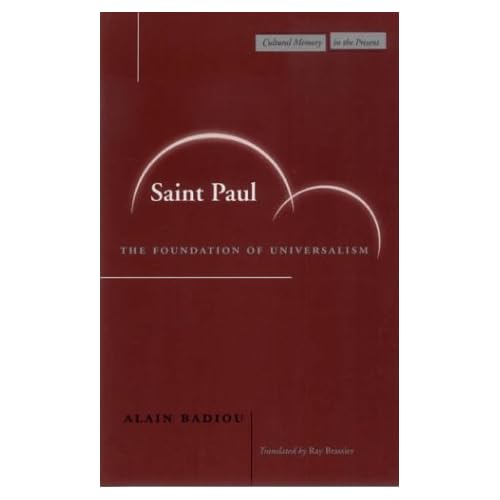
Badiou summarizes Paul's procedure;
if there has been an event, and if truth consists in declaring it and then in being faithful to ti this declaration, two consequences ensue. First, since truth is evental, or of the order of what occurs, it is singular. It is neither structural, nor axiomatic, nor legal. No available generality can account for it, nor structure the subject who claims to follow in its wake. Consequently, there can be a law of truth. Second, truth being inscribed on the basis of a declaration that is in essence subjective, no preconstituted subset can support it; nothing communitarian or historically established can lend its substance to the process of truth. Truth is diagonal relative to every communitarian subset; it neither claims authority from, nor (this is obviously the most delicate point) constitutes any identity. It is offered to all, or addressed to everyone, without a condition of belonging being able to limit this offer, or this address.
This leads Badiou to offer four maxims of the truth as universal singularity as it applies to Paul and to our contemporary context.
1. The Subject does not preexist the event and thus the extrinsic conditions of his existence or identity will be argued against (i.e. neither Jew nor Greek, slave nor free, male nor female).
2. Truth is entirely subjective and therefore under no law.
3. Fidelity to the declaration is essential, for truth is a process, and not an illumination. This process requires the presence of faith (or conviction) at the point of declaration, love as its militant address and hope (or certainty) as the force understanding the completion of the truth.
4. A truth is of itself indifferent to the state of the situation. This requires a distance for the State and from what corresponds to the State in people's consciousness: the apparatus of opinion. One must not argue about opinions, Paul says.
Okay I should actually get to work now, more later.
Thursday, April 17, 2008
Coming Into Existence
In building up his case that the coming into existence of ‘the god’ Kierkegaard reminds us that there was no advantage to understanding the god for those contemporary with him. Coming into existence is an event that is not accessible to immediate sense perception. This is true of all of ‘history.’ History is always that which comes into existence and as such becomes entirely inaccessible to immediate sense perception and enters the realm of belief. This feeble paraphrase from the Interlude in Kierkegaard’s Philosophical Fragments reminded me that no one has ever had direct access to history as such. This is of course obvious but not often made visible or respected in historical discourses.
Sunday, September 02, 2007
Further Thoughts on Immanence in Response
In the world of high-stakes blogging there are the quick and the dead. I am amazed at the speed and depth of post discussions that I have come across. I am beginning to realize that much of what is written feeds directly into or out of published or taught material. I thought I would pace myself and respond to helpful comments directed towards my questions and observations. The firs series of responses comes from the discussion that I directed you to earlier (see here).
Following this I will address the comments made directly in the below post.
The first quote is from Larval Subjects who responded sharply to my thoughts that perhaps notions of the sacred (or at least theologically sensitive aesthetics) may be helpful navigating some the issues being raised.
LS responded by saying that,
Philosophy has abdicated itself when it follows this path [of assuming or requiring transcendence] or ends up in a pious crypto-theology suitable to the needs of priests, despots, and demagogues– immanence, which is philosophy’s vocation since Thales’ declaration that the world is sufficient to itself, requiring no mythological explanation or transcendent beyond, always rejecting any sort of obfuscatory and hypnotic sacred.
I find it difficult to respond to this quote. I also find it hard to be defensible. Either position (assuming or defending either immanence or transcendence) desires a superior perspective; an ability to see behind the assumptions of the other. I will leave further commentary until later.
In a number of respects, I draw my distinction between theology and philosophy from Jean-Luc Marion who rigorously tries to define the limit of philosophy. I differ from Marion in holding that theologies that posit transcendence ought to be left behind. I read the history of philosophy as the history of attempts to think immanence. These attempts can be deployed in a variety of ways, can be more or less successful, and the question of whether or not immanence has ever been fully thought is entirely open. By immanence I understand the thesis that we don’t need to refer to anything beyond, or to any intervention outside the world, to explain the world or to account for value. Consequently, when Thales says “all is water”, he is appealing to a principle of explanation that is strictly immanent to the world and is breaking with mythos or narrative explanations of the world such as those found in Greek mythology.
LS desires to discard reference to anything "beyond" the world. This is a very problematic statement. Again, I can't help notice such a position assuming an indefensible perspective; a seeing of the other side of immanence. I appreciate the example of Thales saying that "all is water". But is the Christian doctrine "God is love" any less a statement of immanence? Or conversely is water the "strictly immanent" principle LS takes it to be? Certainly the use of "water" as ontologically basic differs from speaking of there being "turtles all the way down" though perhaps not by much.
What I hope to clarify in my own articulation is that my using words such as transcendence and sacred are not to be pictured as portals to another dimension. Though I do not have a clear concept of a personal God I also do not consider God and spirit to be somehow "outside" of reality. Speaking of the sacred refers to the relational nature of truth and our inability to control or manipulate it. Transcendence refers to the movements and possibilities of "presence". We are boundaried people but that does not exclude the possibility of communion (and also the transgression of boundary).
What I am wondering is if LS's notion of immanence requires "truth" to always be clean, clinical and reproducible. To be scientific in the most modern sense of the word. I would find this much more frightening that the subscription to fairies and goblins as clinical dissection always requires the death or manipulation of the object and not a relationship with her.
Stay tuned LS had much more to say on the matter.
Thursday, August 30, 2007
Transcedence, Immanence and the Sacred
Much of my thinking and reading lately has come to a head over the issue of immanence and transcendence. In recent blogosphere ventures I encountered several posts on the issue (Larval Subjects here and here, Rough Theory, Transcendental Enquiries). There is understandable criticism over forms of transcendence which need to appeal to something outside in order to explain things or solve things. This of course is the common domain of
My interest in transcendence does not grow out of a need to appeal to something beyond what we can see, experience or explain. However, I also do not assume that humans have the resources or senses to bring all of reality under a loosely scientific model of inquiry and explanation. That may lead some to view my thinking or theory as weak. I am beginning to understand that what I am concerned with is the relational aspect of reality. To paraphrase Nietzsche, “Suppose truth was a relationship – what then?” This is definitely a structural approach to reality. Meaning arises in contextual relationships.
I am however not satisfied with the view that this leads to an evasion of meaning, that meaning is endlessly deferred. This is I suppose where people explicitly or implicitly appeal to a transcendent source to stabilize or deliver meaning. This is where I begin to move towards what may be viewed as an incarnational (any other terms available?) view of reality. What I mean by this is that all of reality, reality as such, has its being (ontology) in a certain potential which as of yet has not bowed and submitted to human colonization. This is where the poetic and aesthetic become most helpful. The poetic respects the possibility of reality. My guiding quote in the header is becoming more and more significant for my thought, “There is another world, and it is the same as this one.” Beauty has not yielded her secrets but she still invites. This is not some plea for something “outside” to clarify or correct. This is the eternal task of relationship, of taking ourselves out of a perceived centre and hovering around the sacred absence necessary for relationship. This in turn leaves not a deferral of meaning but honouring its abundance.
Criticize where necessary. This is certainly a work in progress.
Monday, August 27, 2007
Theology and Philosophy
Check out this post at Larval Subjects. If the post itself does not interest you take a look at the comments section. I waded in over my intellectual head on the debate between philosophy and theology. Larval Subjects made some of the most clear and concise arguments for their separation that I have comes across in a while. Hopefully I can post more fully on some of my reflections after that engagement.
Monday, November 13, 2006
Hope and Philosophy
I have been wrestling with the value of modern philosophical pursuits. Most every “big name” in the history of modern philosophy tends to be reduced in large part to the question of relationship, namely our position in the world in relationship to other people and objects. Some maintained that reality exists in the mind as it provides the organizing principles to interpret the influx of non-meaningful sensory perception (I believe this is basically Kantian). Others argued that the human mind and body exist as a clean slate onto which external objects inscribe reality and meaning (Hume?). I understand this to be the difference between empiricism and idealism. Both of these approaches had a confidence that either the mind itself or the ordering of the material world offered the possibility of stable consistent truth. Derrida appeared to undermine the possibility of a stable or accessible core of truth. All reality is mediated linguistically and words are only understood in relationship to other words and so meaning or access to the world around us remains deferred in its difference. Recently Slavoj Zizek, working from Jacques Lacan, states that,
It is not that we need words to designate objects, to symbolize reality, and that then, in surplus, there is some excess of reality, a traumatic core that resists symbolization – this obscurantist theme of the unnameable Core of Higher Reality that eludes the grasp of language is to be thoroughly rejected; not because of a naïve belief that everything can nominated, grasped by our reason, but because of the fact that the Unnameable is an effect of language. We have reality before our eyes well before language, and what language does, in its most fundamental gesture, is – as Lacan put it – the very opposite of designating reality: it digs a hole in it, it opens up visible / present reality toward the dimension of the immaterial / unseen. When I simply see you, I simply see you – but it is only in naming you that I can indicate the abyss in you beyond what I see.
I admit that these are immature images of these thinkers but I am quite certain that lurking beneath all this technical language remains that basic urge for knowing ourselves and the world around us. I am enjoying my brief tour of philosophical literature but I foresee that I may be wearied if I do not find a vulnerability towards the Real which these writings border on smothering. I am sure that my approach to reality could be quickly classified and dismantled by any rigourous thinker in any of these camps, however the force of authority that I once gave this views is beginning to wane (and perhaps not even enough yet).
The result so far is a renewed vision for the need of witnessing to a personal God. I mean this in no modern evangelical sense of the word. Rather I am coming to recognize that we are in essence relational beings, limited yes, but appropriately equipped nonetheless.
My early response to such stirring is hope.
I hope to return to the poetic which seeks out the cracks and possibilities of language.
I hope to return to the holy which pours through these cracks.
And approaching advent may we look in hopeful expectation to Mother Mary who lived both the intimacy of the incarnation and the experience of shame and the inability to communicate the reality within her (and really who could believe her?).
And finally I hope to find myself in a state of worship which I believe is the only posture in which we may truly participate with Triune God, Creator and Sustainer of our reality.
