
I am on holidays and so I began a fistful of books that have been sitting on my shelf waiting their turn. The three that have emerged this summer are,
Slavoj Zizek, In Defence of Lost Causes
Rowan Williams, The Wound of Knowledge
and my first Jean-Luc Marion, In Excess
I will offer a few excerpts shortly. However, yesterday I was inundated with more books that will have to wait.
I received an order from Amazon which included,
William Cavanuagh's Theolopolitical Imagination and John H. Yoder's The Politics of Jesus (which I read about 10 years ago after which I lent out the copy never to return).
Yesterday I was also out a used bookstore and corralled the following,
Immanuel Kant, Religion Within the Limits of Reason
Max Horkheimer and Theodor Adorno, Dialetic of Enlightenment
Jacques Lacan, Speech and Language in Psychoanalysis
Then to top it all off as I was walking to where I parked my car there was a little Thrift Store that I went into where I perused their bookshelf and for 50 cents I picked up,
Elisabeth Schussler Fiorenza, In Memory of Her
Terry Eagleton, Literary Theory
I need more holidays!
So what summer reading have you picked up?
Zizek's In Defense continues to be an enjoyable read. It is starting to get a little old the way he "turns the tables" on popular conceptions. You have heard it said that Hitler was too violent, well I say to you that he was not violent enough. You have heard it said that Stalinism was immoral, well I say to you that it was too moral . . . and so forth. This however, does not take away from insights into capitalism as the infinitely revolutionary model that can absorb almost all influences. Here is quotes Brian Massumi on the erratic excess of contemporary capitalism saying that,
the more varied, and even erratic, the better. Normalcy starts to lose its hold. The regularities start to loosen. This loosening of normalcy is part of capitalism's dynamic. It's not a simply liberation. It's capitalism's own form of power. It's no longer disciplinary institutional power that defines everything, it's capitalism's power to produce variety - because markets get saturated. Produce variety and you produce a niche market. The oddest of affective tendencies are okay - as long as they pay. . . . It's very troubling and confusing, because it seems to me that there's been a certain kind of convergence between the dynamic of capitalist power and the dynamic of resistance.
Zizek eventually comes to his question and asks, "How, then, are we to revolutionize an order whose very principle is constant self-revolutionizing?" The chapter ends with a quote from Beckett, "Try again. Fail again. Fail better."
Jean-Luc Marion's In Excess is the third in a trilogy of books (which I did not know when I bought it). It is, however, somewhat accessible having not been up to speed with his prior work. Marion asks the question whether the rejection of all transcendence by phenomenology forbids it from engaging constructively with religion. Here Marion looks at metaphysical theology and revealed theology. In as much as metaphysical theology (first philosophy) is based on "real transcendence, causality, substantiality, and actuality" phenomenology could engage in no speculative arguments beyond what is given. However, "for revealed theology, by the very fact that it is based on given facts, which are given positively as figures, appearances, and manifestations (indeed, apparitions, miracles, revelations, and so on), takes places in the natural field of phenomentality and is therefore dependent on the competence of phenomenology. What is surprising here is that phenomenology should disqualify that theology called 'natural' and rational, but it cannot deny further interest in revealed theology, precisely because no revelation would take place without a manner of phenomenality."
The opening chapter of Rowan William's The Wound of Knowledge is worth quoting in full but I will quote one of the final paragraphs after Williams has outlined the paradox and contingent nature of faithful spirituality. He then talks about hope,
The presence of this hope is what makes us alive with 'newness of life' (Rom 6.4) in the sharing of Christ's risen life. Christ's risen life is a life free from the threat of death and annihilation ('Christ's being raised from the dead will never die again' - Rom 6.9), the 'threatenedness' that is part of the human condition of human sin and distance from God. In sharing this life, we share his freedom from 'threatenedness,' it is never - as is perfectly clear in all Paul's epistles - a freedom from exposure to suffering or from fear, but it is a decisive transition to that new level of existence where God is the only ultimate horizon - not death or nothingness. 'From now on, therefore, we regard no one from a human point of view; even though we once regarded Christ from a human point of view, we regard him thus no longer' ( 2 Cor 5.16). The 'human point of view,' for which death is the final horizon, is put away, so that we are free with Christ's freedom. We have, in John's terms, 'passed out of death into life' (1 John 3.14).
Thursday, July 17, 2008
When it Rains it Pours

Friday, June 20, 2008
Little Terror
Zizek quoting Maximlien Robespierre on terror,
If the mainspring of popular government in peacetime is virtue, amid revolution it is at the same time virtue and terror: virtue, without which terror is fatal; terror, without which virtue is impotent. Terror is nothing but prompt, severe, inflexible justice; it is therefore an emanation of virtue. It is less a special principle that a consequence of the general principle of democracy applied to our country's most pressing needs.
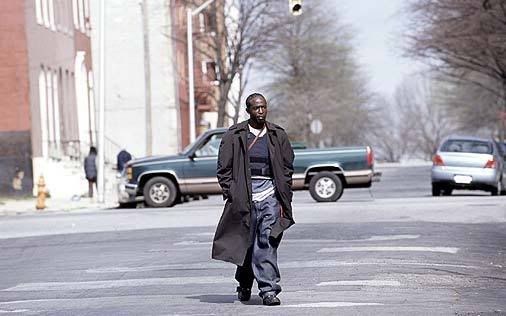
I will set aside any qualitative judgments on that passage and consider whether the stick-up boy Omar Little from The Wire comes close to functioning in that role. A stick-up boy is someone who robs the drug dealers. Omar repeatedly talks about living by a code and when a drug dealer tries to pin a murder charge on him in revenge Omar has some credibility when he tells the police officers, "Did you ever know me to do a civilian?" More than this Omar operates with prompt, severe and inflexible actions. Another aspect of the revolutionary space that Zizek promotes is its radical egalitarianism. Omar runs with a tight group in which he himself is gay and includes his lover, women, and his blind "mentor" Butch.
I suspect Omar's mettle comes from a mixture of suffering (indicated by the giant scare across his face) as well as having a moral/spiritual framework from youth (in one scene he is attacked brining his mother to church). I have as yet to understand the 'human' role that would allow a revolutionary event that I understand Badiou or Zizek to advocate to be anything less than the terror that has occurred in the past.
Wednesday, June 18, 2008
Not Violent Enough
Zizek takes an entire chapter in In Defense of Lost Causes offering commentary on how we might understand Martin Heidegger's connection to Nazism. Zizek dismisses the characteristic justifications for this. 1) Heidegger was never really a Nazi, he just made superficial compromises in order to save what he could of the autonomy of the university. 2) Heidegger was, for a limited period, a sincerely committed Nazi; however, not only did he withdraw once he became aware of his blunder, but the acquaintance with Nazi power precisely enabled him to gain an insight into the nihilism of modern technology as the deployment of the unconditional will-to-power. 3) Heidegger was a Nazi, and there is nothing to reproach him with for this choice: in the early 1930s, it was a perfectly legitimate and understandable choice.
Zizek subtitles this chapter "Why Heidegger took the right step (albeit in the wrong direction) in 1933. He is interested in showing that Heidegger's association rather than being an anomaly or mistake was actually somehow deeply embedded in his overall thinking.
The association of course is not with the extermination of the Jews but with the possibility of revolution. What is sought through revolution is the creation of space, the suspension of temporality, and the emergence of something new. What becomes the criticism of the Nazism exertion of total power was not that it went too far but that it did not go far enough. What Heidegger hoped to address was the primal conflict in being that sustains the social order. This opens the way for Heidegger's discussion on violence. Zizek offers an extended quote,
Violence is usually seen in terms of the domain in which concurring compromise and mutual assistance set the standard for Dasein, and accordingly all violence is necessarily deemed only a disturbance and an offense. . . . The violent one, the creative on who sets forth into the unsaid, who breaks into the unthought, who compels what has never happened and makes appear what is unseen - this violent one stands at all times in daring. . . . Therefore the violence-doer knows no kindness and conciliation (in the ordinary sense), no appeasement and mollification by success or prestige and by their confirmation. . . . For such a one, disaster is the deepest and broadest Yes to the Overwhelming. . . . Essential de-cision, when it is carried out and when it resists the constantly pressing ensnarement in the everyday and customary, has to use violence. This act of violence, this decided setting out upon the way to the Being of beings, moves humanity out of the hominess of what is most directly nearby and what is usual.
It is this sort of thinking that has liberal critics condemning Heidegger as allowing space for such expressions as Nazism in his thinking. Zizek claims that to level this critique is to confuse the two violences. He writes in his typical style,
What one is tempted to add here is that, in the case of Nazism (and fascism in general), [is that] the constellation of violence is rather the opposite: crazy, tasteless even, as it may sound, the problem with Hitler was that he was not violent enough, that his violence was not 'essential' enough. Nazism was not radical enough, it did not dare to disturb the basic structure of the modern capitalist social space (which is why it had to focus on destroying an invented external enemy, Jews).
The courage that Heidegger sought that he did not find in Nazism was the courage to attack, with violence, the ontological order of being that sustained the social order. For this violence to be in some way transformative then it must someone be able to be turned also on one's self.
I am not entirely sure how I feel about this chapter but what it did raise for me was the question of violence in the Old Testament, particularly the 'Conquest Narratives'. What appears to be necessary for Heidegger and Zizek is the presence of totality in revolutionary movements, complete abandonment and commitment. There is this sort of absoluteness in the God's violent edicts of the Israelites entering the land. Reality consists of symbolic actions under the sovereignty of God. The actions of the Israelites needed to reflect complete trust in God. The sin of the people was not the violence but the half-measures of violence. The violence that still in some way served the people themselves. I am running out of steam and time here but the further question would then of course be how this relates to the question of violence and Jesus. Is there any sense in which Jesus acted as 'violent one' in order to open up the space of transformation?
Tuesday, June 10, 2008
God Forbid . . .
My mother-in-law was out for a visit recently (no not a set-up for a bad joke) and visiting Chapters she said I should pick out a book. After much soul-searching and gnashing of teeth and I was trying to decide between Taylor's A Secular Age and Zizek's In Defense of Lost Causes. I thought I would wait for the paperback of Taylor's tome (it also seemed a little referency for me) and decided on Zizek. Some of his work is joyfully accessible, namely chapter two's abundant movie critiques. However, all too much of it is still a little over my poorly formed political and psychoanalytical head. I was caught by a section on his critique of democracy, or his critique of the critique of democracy. Zizek views Wendy Brown's work on Nietzsche as all too un-Nietzchean as she reducing him to one who simply nudges us from slumber with no real attempt at changing us towards "a positive liveable project 'beyond democracy.'" He goes on characterize her application of Nietzsche and here I immediately read the word pastors in place of theorists. Fair . . . unfair?
Brown thus accomplishes a domestication of Nietzsche, the transformation of his theory into an exercise in 'inherent transgression': provocations which are not really 'meant seriously,' but aim, through their 'provocative' character, to awaken us from out democratic-dogmatic slumber and thus contribute to the revitalization of democracy itself . . . This is how the establishment likes its 'subversive' theorists: harmless gadflies who sting us and thus awaken us to the inconsistencies and imperfection of our democratic enterprise - God forbid that they might take the project seriously and try to live it . . .
The only change I might make is that in the church we also don't like to get stung. This is all the more acute for me as this Sunday I will be preaching on the relationship between Europeans and Canadian aboriginals . . . throw in the fact that tomorrow our prime minister will be offering some formal apology for our residential school system that sought to 'assimilate' natives into the European construction of Canada.
