Showing posts with label culture. Show all posts

Sunday, March 08, 2009

Another World

Having fled the cold of the north I am writing this post in the comfortable shade of the sunny retirement haven of Yuma Arizona visiting my parents.  A few recent thoughts and experiences have converged which I would like to reflect on.  Last week Conrad Grebel College in Waterloo hosted its annual School for Ministers.  The keynote speaker was Duke University’s newly minted professor of homiletics.  He talked at length about the foolishness of both the Gospel and also the foolishness of preaching.  He drew his inspiration from court jesters and holy fools.  He spoke about those risky and vulnerable people who turned ideas and norms on their head.  These were people who had no ‘real’ power and so they subverted power through creative resistance.  Overturning dominant ideas and cultures is also, partially, the theme of Michel de Certeau’s The Practice of Everyday Life which I have just begun to read.  In his introduction de Certeau introduces what he calls rhetorical tactics.  He refers specifically to the Sophists who were known for making the ‘weaker’ position appear ‘stronger’.  In his book as I understand it de Certeau will analyze the different manners of ‘consuming’ in relation to dominant and marginal expressions.  What I think he means by this is how we appropriate and re-appropriate our culture’s ‘raw materials’. De Certeau looks to the indigenous people’s response to Spanish colonizers as an example. 
“Submissive, and even consenting to their subjection, the Indians [sic] nevertheless often made of the rituals, representations, and laws imposed on them something quite different from what their conquerors had in mind; they subverted them not be rejecting or altering them, but by using them with respect to ends and references foreign to the system they had no choice but to accept.”
Yesterday Chantal and I participated in a common Yuma pastime which is parking near the border to Mexico and then walking in the small Mexican town of Los Algodones.  Seniors flock to Algondones for cheap medications, dental work, prescription glasses, booze, and anything else they can haggle down to something they can boast about when they return home.  There is a cultural shift when you enter this town.  Things are no longer fixed or stable.  Everything is open-ended lingering with a question mark.  Is this real silver?  Is the water safe?  Can I trust the dentist?  Am I getting ripped off?  Americans and Canadians think they can come and secure a deal, fight in the market place for the best deal.  They come assuming they are in charge because they bring the money.  But everywhere the locals control the playing field.  Nowhere was this more clear and more ironic then in the Mexican restaurant that we ate in.  The dining area was filled with grey hair, pale skin, and high socks.  For entertainment there was an old local man with a ball cap pulled over his head slouching on a chair.  He sang with a keyboard accompaniment.  It was difficult to make out his words until he broke into his own rendition of God Bless America.  His almost imperceptible lyrics suddenly swept through the dining area like a tidal wave until the whole room culminated with a roar, God bless America my hooome sweet hooooooooome!  As a Canadian this of course struck me as odd (later his Canadian national anthem was met with silence).  More than this though I couldn’t help but think the man simply enjoyed making the people ‘dance’.  It was almost as though Algodones was able to parody in its little village the way that the U.S. has been able to treat countries like Mexico.
There always remain subtle but potentially powerful expressions within our ability.  Our context and circumstances furnish a particular environment that we cannot always change but how we appropriate these raw materials is always a negotiation.  We are able to create worlds within worlds.

Read More...

Sunday, August 31, 2008

Good Will Hunting on Relationships

Good Will Hunting was recently on TV and as I watched Will's childhood gang go bar-hopping and street-fighting I was reminded of the masculine ability to form intimate tribes between the ages of 17 and 25. Towards the end of the movie Chuckie (Ben Affleck) confesses to Will (Matt Damon) that he hopes one day Will won't answer the door when he comes to pick him up because he has used his knowledge to get out of south Boston. Through most of the movie Will rejects opportunities at love and work guarding himself and staying safe with his gang. At the end of the movie Will finally leaves his tribe for both love and career. I can in many ways relate to leaving my tribe at around this age. My hunch is that men become increasingly lonely after the age of 25. There may be a period from 25 to 30 where we are absorbed enough in pursuits not to notice it too much but it eventually surfaces. Are the sorts of relationships portrayed in this movie only applicable to a certain stage of life? Does our culture of romantic love and powerful career sever these relationships unnecessarily? Anyway, I miss my old tribe. And in case you forgot, here is a great scene.

Read More...

Monday, August 11, 2008

Confession; Or Mixed Martial Artist as Hebrew Scholar

On occasion we run across blog entries that give us a glimpse of the all-too ordinary lives of the bloggers. The bloggers begin with some shame in their confession wondering if the few readers they have could possibly respect them after such a confession. Perhaps it is professor of sociology admitting they watch (and are addicted to) American's Next Top Model or an admitted film snob confessing his guilty pleasures. Well anyway, here goes.

I grew up enjoying wrestling. I had two older sisters and so I never got many chances to wrestle growing up and so I watched the WWF or bush league AWA and wrestled with pillows in my basement. Now, fortunately, over time I drifted away from the wrestling entertainment business and in 1993 I came across something else. I am not sure if I heard about first or simply saw the VHS cover in a small corner store in my town that rented videos. It was called the Ultimate Fighting Championship. And for four seasons I watched fighters with backgrounds as diverse as boxing to Samoan Bone Crushing come together to test their skills. And for four seasons (except one due to dehydration) I watched the 165 pounder Royce Gracie beat them all.
In retrospect I see something actually quite beautiful in that convergence. It was a truly interdisciplinary step (though it was of course admitted that it favoured some). I lost track of UFC for years until this year. In our recent move we now get some channels that play some UFC matches. Things have changed. There are now time limits and rounds and they stand up the opponents if there is not enough 'action'. The shift has moved away from free-style and is geared now towards a more 'exciting' fight. Plus nearly everyone is now trained in the style Gracie introduced.
This being said I started seeing previews for UFC 87 and got swept up by the hype. The day after the pay-per-view event I scoured the internet looking for highlights. I found my body tensed through each round and my emotions shifting from exhilaration to fear and concern. I witnessed respect and sportsmanship (among most). And heard the stories of those who left Wall Street to fight or how grew up homeless and found this as a way out. And highly anticipated the main event for the night the welterweight champion (and Canadian) George St. Pierre vs the scarper Jon Fitch (if you really want to you can see the fight here).
So anyway, what can I say I really enjoyed the fights. I do not translate this directly into a popular masculine spirituality. How do I justify or understand this expression? To be honest I am not sure. I actually find these matches more respectful than most other sports. In other sports there is always the temptation to 'cheat' in order to gain an advantage. In the UFC I believe the only rules are no biting, eye gauging, punches to the back of the head and groin shots (though they wear cups) and I have never seen someone try to use these things to there advantage. I don't think these guys are saints, but I do think the nature of the sport allows for more 'honest' competition.

I suspect at bottom the allure of these competitions is the basic desire to be King of the Castle to be capable of some expression in which we are able to control our environment. In this way I can relate my interest in mixed martial arts to my interest in Hebrew in college and philosophical theology now. In college I held firmly that the Bible was the final authority on truth and practice and so in order to best control the play of interpretations I studied the biblical languages. In this way I could use this authority to legitimize or undermine interpretations (and thus control the playing field). This gave way to the study of hermeneutics and its role in philosophy. I began to think that there were philosophical assumptions that guided my interpretations and so I needed to master that field in order to remain in control. Our actions are almost always in the service of stability.
. . . Wait! This is supposed to be a confession! Only guilt and shame, no excuses! Anyone else? The pastor is in . . .

Read More...

Saturday, August 09, 2008

Kill the Postmodern Story . . . But Let Postmodernism Live

I don't have much issue in speaking of postmodernism as a legitimate cultural/intellectual expression (though D. W. Congdon may disagree). I have a difficulty denying the crisis of stable representation and meaning across disciplines as significant 'shift' of some sorts. What I am coming to suspect is that it may in fact be the postmodern story that is the lie in all this. I can remember about ten years ago sitting in an undergraduate class on the sociology of religion learning about the new postmodern reality with its 'incredulity towards metanarratives' and its fragmenting into local, tribal stories. Since then I have heard that story recounted innumerable times in the service of various church related often 'emergent' projects. It has become the default preface in any attempt of the 'new'.
It seems clear to me now, made increasingly clear through writers like Zizek, that the Story of capitalism only grew stronger and incarnated or birthed or abducted the postmodern story as a mode of infinite market production. As quickly as there was any possible life to the postmodern story it was as quickly enveloped into the market. The Master Signifier of the Market has now been able to hide behind the multiplicity of the many expressions all of which offer no true alternative to the current economic model. The postmodern story it seems to be one initiator in this ongoing production.

Read More...

Friday, June 27, 2008

Junk Mail

I haven't figured out how to set better junk e-mail restrictions on Outlook and so I have to do a lot of deleting every morning. There is a preview pane to see e-mails before you actually open them. Sometimes I smile a little at whatever one-liner is included, mostly I am disturbed at how many ways the penis can be referred to as a love 'weapon'. But this morning I just laughed,

Remember there was one dwarf that Snow White loved the best, the one with the big wang.

Read More...

Friday, June 20, 2008

Little Terror


Zizek quoting Maximlien Robespierre on terror,


If the mainspring of popular government in peacetime is virtue, amid revolution it is at the same time virtue and terror: virtue, without which terror is fatal; terror, without which virtue is impotent. Terror is nothing but prompt, severe, inflexible justice; it is therefore an emanation of virtue. It is less a special principle that a consequence of the general principle of democracy applied to our country's most pressing needs.

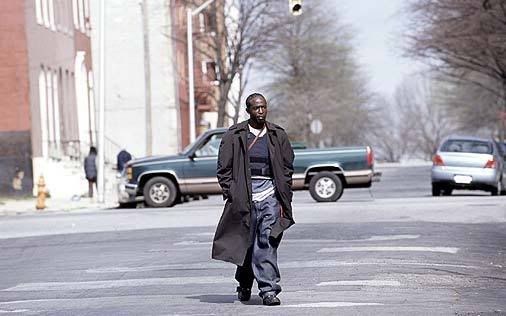
I will set aside any qualitative judgments on that passage and consider whether the stick-up boy Omar Little from The Wire comes close to functioning in that role. A stick-up boy is someone who robs the drug dealers. Omar repeatedly talks about living by a code and when a drug dealer tries to pin a murder charge on him in revenge Omar has some credibility when he tells the police officers, "Did you ever know me to do a civilian?" More than this Omar operates with prompt, severe and inflexible actions. Another aspect of the revolutionary space that Zizek promotes is its radical egalitarianism. Omar runs with a tight group in which he himself is gay and includes his lover, women, and his blind "mentor" Butch.
I suspect Omar's mettle comes from a mixture of suffering (indicated by the giant scare across his face) as well as having a moral/spiritual framework from youth (in one scene he is attacked brining his mother to church). I have as yet to understand the 'human' role that would allow a revolutionary event that I understand Badiou or Zizek to advocate to be anything less than the terror that has occurred in the past.

Read More...

Thursday, May 01, 2008

They Purchase it in Order to Improve the Economy

Last night I received a phone call from Ipsos Reid. For some reason I had it in my mind that this was a government or public survey company. I forget the woman's opening line as to the importance of this survey, I am sure the word 'improvement' was in there somewhere.

The first question seemed important enough.
(her) Q - What would you say is the most important issue that the Canadian government should be addressing.
(I immediately thought of the war in Afghanistan, but that seemed to be somehow a programed response. After thinking for a moment . . . )
(me) A - The need to create sustainable jobs and address the increasing income inequality.

There were perhaps one or two more questions on politics and then suddenly there was a dramatic shift.

(her) Q - What would you say is the most frustrating aspect of shopping?
Is it
a) Fumbling in your pocket for change?
b) Having to swipe your debit card?
c) Waiting for someone else to be through ahead of you?

(wheels slowly started to turn in my head)
(me) A - Ummm I'm not too concerned about any of those things.
(her) Q - How much time would you say you spend shopping in a given week?
Is it
a) 10 minutes
b) 30 minutes
c) 1 hour
d) 2 hours or more
(me) A - Ahhh . . .
(me) Q - what did you say this research was for?
(her) A - Oh don't worry all of this information will be confidential
(me)Q - (in my head - so no one reads it)
(me) Q - So you have companies purchasing this information?
(her) A - Yes they purchase it in order to improve the economy (or seriously something like that)
(her) Q - Do you want to continue this survey?
(me) A - No.

It was interesting that this morning I just began reading an article by William Cavanaugh called The Unfreedom of the Market. Part of what he addresses in the inequality of information between producer and consumer. This information empowers companies to play on our desires and frustrations while keeping their realities highly veiled. Geez I almost gave my goodies away for free!


It is of course true that advertising does not work on each individual like a lobotomy does. Tracing cause and effect is difficult. The individual does not react like a programmed zombie upon being exposed to effective advertising. As Michael Budde puts it, being subjected to advertising is more akin to playing poker against an opponent who, unbeknownst to you, has already seen the hand you are holding, in a slightly blurred mirror. You still exercise free will, but the dynamics of power have shifted because the situation is set up to advance the interests of others. This imbalance of power happens in two related ways. First, surveillance ensures that the balance of information is decidedly in favor of the marketer. Not only do marketers withhold information about a product from consumers, or divert their attention to evocative images unrelated to the product itself. Marketers also gather extensive information about individual consumers and target their efforts based on this disequilibrium of knowledge. Erik Larson details this phenomenon in his book The Naked Consumer: How our Private Lives Become Public Commodities. Larson began research for the book when, a few days after the birth of his second daughter, a sample of Luvs diapers showed up on his doorstep, courtesy of the Procter & Gamble Corporation. His eldest daughter had already received birthday greetings, just days before turning one, from a marketer on behalf of several corporations such as Revlon and Kimberly-Clark who were selling toddler-related merchandise. Larson describes how information on our purchasing patterns, births, deaths, political views, educational levels, credit histories, pet ownership, hobbies, illnesses, and so on is harvested from credit card records, bank statements, hospital records, websites visited, answers to surveys, frequent buyer cards, even filmed records of our shopping habits in stores. Such surveillance has become incredibly sophisticated: a flyer for "OmniVision," a system developed by the consumer intelligence service of Equifax, boasts "We think we know more about your own neighborhood than you do, and we’d like to prove it!"

Read More...

Monday, March 31, 2008

Forthcoming . . .

In the Pastoral Care class that I am taking (recommended for me en route to ordination) I am writing a paper on ministry to men. This allowed me to finally spend some time reading and reflecting on the larger issue of gender. I will be posting on this topic briefly. For now sit back and enjoy a clip from Godmen the newest men's ministry in America. A recent article noted the lyrics to their 'cowboy up' style worship. The title of the song . . . Grow a Pair.
"We've been beaten down / Feminized by the culture crowd /
No more nice guy, timid and ashamed / We've had enough, cowboy up /
In the power of Jesus' name / Welcome to the battle /
A million men have got your back / Jump up in the saddle /
Grab a sword, don't be scared / Be a man, grow a pair!"
(Blade, you may want to steer Anthony in this direction)


Lord have mercy
Christ have mercy

Read More...

Friday, February 01, 2008

Alternative Education?

Anyone want to weigh in on the recent approval for the development of "black schools" in Toronto? There are already a number of alternative schools available which segregate communities at least in terms of economics. I am quite sure that our local private Mennonite high school does not limit enrollment to confessional belief (as I belief there is at least one Muslim student enrolled). The heat of course is in part historical after such effort was made for integration out of the civil-rights movement. The argument now is that black students in Toronto are statistically not succeeding and the belief is that this is in part due to the structure and content of the school system. The premier of Ontario has recently called to a stop to this decision. I don't have a real clear response as of yet . . . how about you?

Read More...

Tuesday, January 29, 2008

Dividing Our Time

I came across this quote by Albert Einstein,

Yes, we have to divide up our time like that, between our politics and our equations. But to me our equations are far more important, for politics are only a matter of present concern. A mathematical equation stands forever.

I find it represents well the tension I often carry with what sort of time I will give to various pursuits. I already took some comfort in the limited time I spend reading 'current events' with the statement made by M. Swann in Proust's Swann's Way in response to value of reading 'the papers'.

The fault I find with our journalism is that it forces us to take an interest in some fresh triviality or other every day, whereas only three or four books in a lifetime give us anything that is of real importance. Suppose that, every morning, when we tore the wrapper off our paper with fevered hands, a transmutation were to take place, and we were to find inside it - oh! I don't know; shall we say Pascal's Pensees? . . . And then in the gilt and tooled volumes which we open once in ten years . . . we should read that the Queen of Hellenes had arrived at Cannes, or that the Princesse de Leon had given a fancy dress ball. In that way we should arrive at the right proportion between 'information' and 'publicity'.

Here Proust also refers to a 'division', or as he calls it a right proportion. I still hold to the position that I will be better equipped for political significance if I am formed by transformational texts (and contexts) and I am sensitive and alert to my immediate environment. And then I may well be able to understand what Stephen Harper is proposing for Canada.

Read More...

Wednesday, January 09, 2008

Conversion or One Flew Over the Cuckoo's Nest

No time to comment but I have only recently come across the story of Antony Flew. Worth checking out.

Read More...

Tuesday, December 11, 2007

Sanctuary - Part II

There must, must be sustained commentary around the recent church shooting in Colorado. There is so much that is deeply disturbing about this issue. First and foremost in my mind is the presence of an armed security guard who killed the gunman. In one AP article this person "is hailed for saving countless lives in shooting a gunman outside her church". Her acts as saviour are recounted in several articles. This event has also fed into America's Homeland Defense Machine explored in another AP article. Here are a few excerpts.


Churches want to present an open and welcoming image, but in an era of mass-casualty shootings and terrorism threats, the violence at New Life highlights a new emphasis on security. Some of the nation's estimated 1,200 megachurches — places where more than 2,000 worshippers gather each week — have been quietly beefing up security in recent years, even using armed guards to protect the faithful.

Meanwhile, many more, often smaller congregations typically don't have detailed security plans because they don't have the money or don't want to risk turning people away.

At Potter's House, a Dallas megachurch led by star pastor T.D. Jakes, a private security company employs a team of armed, unarmed, uniformed and plainclothes guards that keep watch over crowds in the thousands. Under a new Texas law, all nonprofits must use licensed security guards, and the church hired Classic Security in response, said Sean Smith, who formerly led the church's security detail and now works for the company.

For the past three years, Potter's House has hosted a church security conference, drawing more than 400 people this year to sessions on surveillance, background checks and other issues. Although precautions can be costly, money spent on security can end up being far less than liability and lawsuit risks if no action is taken, the church says.

"You see (security) anywhere but churches," Smith said. "You see it in malls, at banks, at concerts. Somehow, at churches we feel immune to violence. But it's been proven not to be the case."

Even without a security department, churches can train volunteers to keep watch for suspicious behavior, such as a visitor dressed in a long coat in summer or not making eye contact with anyone, Smith said.

The security plan at New Life Church may seem extraordinary. The church's volunteer security force is stocked with people with military or law enforcement experience, they carry radios and weapons, and there are evacuation plan calls for hustling worshippers into "secure zones" in the case of emergencies.

I am not sure what is worse armed guards at churches or churches not having them because they don't want to turn people off. Are those the only two views? That churches are one of the only places where you don't see guards is a great opportunity to explore its unique social space but is here restricted to the idea that we are simply being naive. Where once we could perhaps look on "suspicious behaviour" as the context for witnessing to the grace offered in our faith it is now the criteria for confinement and judgment prior even to crime. And perhaps theologically most profound is the concept of moving people out of the sanctuary into "secure zones". That the space of communing with the One to whom is the "kingdom, the power and the glory" is less secure than that created by the boundaries of humans is cause for needed reflection.
Now this of course was no ordinary church under attack. This was the church founded by Ted Haggard. Hear some of the responses by church members and leaders.

"Even back then (when Haggard was pastor) we had people undercover in the congregation who were armed," Dodd said. "It was a big church at the time, it was Christian, and some people really hate that stuff.

"Not only do we have military and ex-military all over, we have this sort of frontier mentality. People around here are serious about protecting their own."

. . .

Assam, the security guard, had attended the church's early worship service at 9 a.m., then stood watch in the rotunda of as the second service was letting out.

There, she confronted the gunman, identified as 24-year-old Matthew Murray. Murray managed to two kill two sisters and wound their father and two others before he was killed. At a news conference Monday, Assam said that she prayed for the Holy Spirit to guide her, and that her hands never shook.

"It seemed like it was me, the gunman and God," Assam said.

Speaking of the church's security plan, Boyd said: "That's the reality of our world." He stressed that all armed guards are licensed and screened.

And with respect to the larger political response.

The Homeland Security Department created a grant program of nearly $50 million to improve security for religious and secular nonprofits considered at risk of terrorist attack.

Several groups have received individual grants, according to Homeland Security officials.

The Fellowship of the Woodlands megachurch in Texas employs a former FBI agent as a full-time security director, overseeing volunteers and paid staff, said pastor Kerry Shook. Those who are armed in the congregation are police officers, he said.

"It's something you just have to do today," said Shook, whose congregation draws 15,600 people per weekend. "We want everyone to feel safe. At the same time, we want to be open and accepting of everyone. An incident like this one in Colorado Springs just reinforces what the church is — we have to be a light in a dark world."

It is difficult to understand how you are being a light when you are simply producing the same reality as the culture around you unless of course you believe that your culture is the light of the world. And I do suppose this is the thinking here.

Read More...

Sanctuary - Part I

A great post over at I Cite articulates what I imagine many of us are feeling, especially at this time of year. Referring to a recent shooting at an Omaha mall this news article is quoted.

"Obviously, there is a period of time for mourning, a very appropriate time," Kavanagh said. "But . . . people have a connectivity to their center."

A person's favorite mall can be the site of first jobs and first dates, and it offers familiarity and comfort, Kavanagh said.

That makes something like Wednesday's shooting even more horrific, he said.

"It's sort of an invasion of a sanctuary in some terms. It will take time for some to go back, but others will go back immediately, almost in defiance of this individual."

Some morning radio deejays this week exhorted listeners to return to Westroads to shop as soon as it reopens.

I Cite comments,
The mall as violated sanctuary, the sacrosanct temple of consumption. This strikes me as infinitely more horrific than the fact that in a country unwilling to disallow weapons people sometimes shoot each other. The comfort of the mall? It sounds like a small town, but one without incest and abuse, alcoholism and suicide, lynchings and cross-burnings. Even the mall has its obscene supplement. But the shooter isn't it; the shooter is barely a symptom. Rather, the obscene supplement, what we have to suppress even to go in, is the truth that the people who make most of the products cannot buy them, that the people who provide most of the services cannot afford them, and that, really, we don't even want them. We go because it's all we know to do; it's the only sanctuary left. All those other sites we've imagined have lost their appeal.

It is the final comment that cuts deeply in my thinking. We go because it's all we know to do; it's the only sanctuary left. There remains few social activities that are not based in some form of economic consumption. The sanctuary in the Old Testament was based in the centrality of a generative presence and I see this connected to Mall as Sanctuary at least in the basic hopes of what consumption will offer.

Read More...

Saturday, July 21, 2007

The Image is Everything


Sifting through some old pictures I knew at some point that I would come across this one. This was taken about 10 years (that's right boys) at a Zao show in some dingy little house on the outskirts of Seattle. Other than the local Winnipeg Christian hardcore scene (which in retrospect was really quite good) this was my first hard-hardcore show. I absolutely love this picture. Centered in the frame is the trendy rock-a-billy kid (does that still have currency?). Then to the left is the tough guy, face grimaced, thrusting a poor kid into the fray. Then on the right is a guy pulling off three stellar moves. First he is shark position with his left hand raised to enter the water. For added hardness he sports the teddy-bear (anyone want to make something of it!). To top it off he's got a guy in a full choke hold, with his victim still trying to bust out some of his own moves.

For those of you new to hardcore dancing see the following helpful videos,

"How to Hardcore Dance"
(Ah, I'll never forget when Kev introduced to the world of hardcore dance in my dorm room. Yes this video is terrible I know.)

For other equally horrible hardcore dance instructions see here and here


"The Origins of Hardcore Dancing"
(Sorry a couple of f-bombs in the song being played here but it was sooo good. Notice how even the choke-hold was evidenced in these humble beginnings)


"Hardcore dance Drive-by"

Read More...

Wednesday, July 11, 2007

Christ and Culture


The cover image of Graham Ward’s Christ and Culture is Caravaggio’s Doubting Thomas. The sensuality, grace and revelation communicated in this image infuses Ward’s text. Take the most graphic aspect of the image in Christ pulling back his robe guiding Thomas’s finger into the spread flesh of Christ’s wound. For Ward this represents how our concept of an erotic relationship is taken up into a larger spiritual or divine economy. Whereas Jesus’s post-resurrection encounter with Mary re-images a relational intimacy calling to mind Eden or Song of Songs so too Jesus’s post-resurrection encounter with Thomas employs erotic dynamics of sexual-spirituality. Ward quotes Luce Irigaray, “In the body of the Son of Man there appears, in the form a wound, the place that, in women, is naturally open.” (140) Ward reminds us of John’s testimony to the blood and water flowing from the wound of Jesus. Ward moves away from vulgar accounts of sexuality and erotic relationships as ends in themselves. In this way Ward is able to speak of the erotic relationship to Christ because “it is the completion or perfection of what is most desired in sexual intimacy; sexual intimacy being an intimation of the divine relation that operates between God and human beings.” (109) This allows substantial critiques and opportunities to engage the poverty of modern sexuality as well as more vigorous interpretations of such texts as Song of Songs and Paul’s analogy of the church as bride.

Another key aspect of Ward’s work is his discussion on the kenotic nature of Christ, that is, the giving or emptying aspect of his life and death (see Phil 2:5-11). The self-emptying of Christ is also set within the context of embodiment and sensuality. Our basic existence flows from our being a center of “touch”. We are covered in that which feels. Even our other senses are also centers of touch. In self-giving our “self” rises to greater extents to the level of touch and participation with the world around us and with that further away from any positions of “self”-centeredness. With Christ’s self-emptying he actually becomes the space that separates us from God and each other. I will need to re-read much of these sections as the subtleties are not altogether clear to me. However, one of the implications of this thinking is in the reading of Scripture. Reading Scripture becomes a spiritual exercise in which we dwell in the space of the Word. To bear fruit in the Word is to participate in the emptying dispossessed self of Christ were sign and meaning cannot be controlled or fixed but received and reflected. Here allegory becomes the dominant mode of communication and “a sacred space is opened. . . . This space can neither be limited nor defined.” (240) Meaning that emerges though is not arbitrary or relative though it is relational, being brought into relationship with the canonical Scripture, interpretive communities, and the living God keep the text is kept from being dominated hermeneutically. Taking seriously limited nature of human perception Ward writes that “Knowledge of God can only issue from allegory, an allegory created as the invisible operates through the visible, an allegory created by infinite love.” (243)

Ward offers a tremendous vision for a non-modern account of Christ and culture.

Read More...

Tuesday, June 12, 2007

A Grimm Tale


I recieved a Chapters gift certificate and returned from the store with Marilynne Robinson's Gilead. And another book that his been in the back-burner of my mind for some time now. Browsing through the cultural studies section I came across the title The Complete Grimm's Fairy Tales (with commentary by Joseph Campbell) and knew I found what I was looking for. The first tale in the book was the Frog King. I had some familiarity with the story and was waiting for the moment when the princess would kiss the frog and turn him back into a prince.

In the story the frog helps recover the princess's favourite toy, a golden ball. The frog does it on condition the the princess will bring him back with her. After the frog retreives the ball the princess backs out on her deal and goes back to her castle. The frog eventually finds his way to the castle and the king makes the princess take him in. The frog keeps demanding more and more from the princess until he asks that he can share the bed with the princess. The frog says, "I am tired and I want to sleep as well as you, lift me up [into your bed] or I will tell your father." And the story follows,

At this she was terribly angry, and took him up and threw him with all her might against the wall. "Now will you be quiet odious frog?"

At this the frog turns into a prince and they get married.

Read More...

Saturday, May 12, 2007

A Complex Character or Just Another Straw Man?

In it is an old story that Hollywood has tried to distance itself from the black and white hat characters of the westerns. Characters now are supposed to be more nuanced and complex; neither good nor bad but human. The camera has attempted to penetrate the thin facade of suburbia uncovering such stories as American Beauty. I recently viewed Little Miss Sunshine (just so you know this post is full of "spoilers") and was, through most of the movie, pleased. A little girl in a middle-class home finds out at the last minute that she has a spot in the Little Miss Sunshine beauty pagent. The family is complete with recently fired gay suicidal academic uncle, angst-ridden son who reads Nietszche and has taken a vow of silence, a perverted heart-of-gold grandpa, a bring-home-the-bacon mom, and aspiring motivational speaker dad who is trying to cut a book deal on how to be a winner. And that is the plot. Who are the winners and who are the losers. And what better backdrop than there last minute attempt to drive 1000 miles to a beauty pagent. The bulk of the movie is spent on the road where grandpa dies, the son finds out he can't pursue his dream job, the uncle meets his ex-boyfriend who ran off with another scholar, and the dad loses his book deal. All have lost. All are losers.
However, they do manage to make it the pagent in the nick of time. Olive's turn for the talent competition comes up. Olive has been working on her routine with grandpa and no one has seen it. However, after seeing the other contestants dad is feeling like her girl is outmatched and wants to convice her not to go on. Mom stops him and allows Olive to perform.
It turns out that Olives performance is a pre-pubecant strip-tease which is performed to Super Freak. The audience is offended and begins to leave. In act of triumphant solidarity the whole family comes on stage to dance with Olive for the remainder of the song.
It is all fine and good to critique society via "beauty pagent" imagery, however, sex is once again leveraged as the liberator of docile mass culture. In fact I believe sex is a good domain to critique but does an "innocent" six year old strip tease offer a redemptive image for dysfunctional families and lives? As I write this I am beginning to see that perhaps Olive and the rest of the family are significantly "complex". Through Olive's purity she translates grandpa's strip tease into a redemptive act liberating the family for the expectations of the beautiful culture, the winners. While I respect Olive's character I view the old Hollywood character of Sex as suspect. Sexual deviance remains the leading man for cultural change in Hollywood. Much of Hollywood remains convinced that sex is primal and does not reflect on how sex offers imagery for the deeper movements of holiness, the real complex character.

Read More...

Wednesday, April 18, 2007

The Race Card

I will not play it again. I said my piece with Michael Richards below. Here is a link to one perspective on Imus, Snoop Dog and Race.

Strange Behavior

Read More...

Monday, February 05, 2007

Previously Unreleased

I have been in a bit of cultural rut when it comes to exploring new emerging experssions. Recent times have found me charting paths past all the great, and other than great, artists staking claims on the web. Thus the introduction of IndieVision and MySpace of the Moment. These sections will be updated regularly with whatever catches an ear or an eye.
I hope to post some of my recent reflections on the "Soundtrack of My Life" that I shared with my sunday school Class this week.

Read More...

Wednesday, January 17, 2007

The Davinci Code

(Warning! If you still haven't read or watched The Davinci Code you probably don't want to read this)

I suppose most of the hoopla has died down by now but I finally watched The Davinci Code (I am not sure I will ever have the time to read it). On my first viewing I thought the movie was quite good. I am sucker for cryptic suspense. I enjoyed it right up until it began to start sermonizing in the last 10 minutes.
No Sophie was no proven to be an heir of Christ. So in response Langdon offers the painfully repetitive refrain of the western modernity, "the only thing that matters is what you believe." Really? That is how world-renowned historian Robert Langdon sums up his world view? No, that is not all. He follows to say that "history shows that Jesus was an amazing example, a human inspiration, that's it. That's all the evidence has ever proved."
What?! How has that been proven?
Anyway . . .
Then Langdon returns to the story of when he fell down the well as a child where he reveals to Sophie that he prayed to Jesus. He thought that perhaps he was not alone. To which he comes to the conclusion. "Why does it have to be human or divine. Why can't it be that human is divine?" Correct me if I am wrong but isn't the whole paradox of orthodox the believe that only Jesus is human and divine?

I do not want to undervalue that aspect of the movie because I believe there is validity in someone reaching out and experiencing the presence of the unknown. I just have an issue with how it was framed here.

I also find some validity in Langdon's next question. "Why couldn't Jesus have been a father and still capable of all those miracles?" I think that is a pretty good question. I don't really have thoughtful answer for it. Unless perhaps part of the Jesus's celibacy was to remove biological gender from the issue of salvation.

Of course in the end the "debunking" of orthodoxy is secured in the reliability of our hero Langdon as he uncovers the true resting place of Mary Magdalene and so bolsters a view that critical reason has finally prevailed over the myth of Christianity, though it cannot over conclusive proof.

This is a fairly unnuanced post and a little late in coming for the discussion but there you go.

Read More...