
In his classic work on Prayer Evagrius of Pontus writes,
"When you are praying the memory brings before you either fantasies of objects from the past, or recent concerns, or the face of one who has caused you hurt."
It is well known (or at least popular history) that the final years of Proust's life were spent largely in a sound proof room in Paris where he wrote at night and slept during the day. Here he completed his metanarrative À la recherche du temps perdu (In Search of Lost Time). I am in the final stages of reading the first of the seven volume literary cosmos Swann's Way.
Swann's Way is a meditation on memory and the sublime. Under Proust's pen every instant (every memory) is infinite. In his secluded final years memory dominated him as he wrestled with the faces of love and hurt in his monastic cell. And it was two faces that emerged; one was a young boy's mother in first half of the book and other being M. Swann's lover Odette in the second half.
I read both relationships as exploring the basic human sense of insufficiency. Being alone with your self stands as a terrifying prospect for most individuals. I am not referring to being by yourself but being alone with yourself; to travel inward and commune with what you encounter. This was Proust's journey and as Evagrius points out when you travel inward (typical language for the movement of prayer) you will encounter memory and you will encounter the wound that drives our compulsions. The beauty of Proust's life and work (as I limitedly understand it) is that this movement and intentional uncovering was his healing as his life reflects a solitary communion with self. What Proust offers us is a vision of how attentiveness in life (again typical language of contemplative prayer) opens the gratuitous (infinite?) reality of life. This did not come from fleeing his wound but allowing it to be a generative place in his thought.
Proust entertains only a sort of contemplative memory. As he begins to enter his childhood experience he realizes that he could indeed recall more factual memories of his life in Combray but these came through "an exercise of the will", his "intellectual memory". Here again we hear mystic imagery. St. John of the Cross distinguishes sharply between meditation and contemplation. We can do meditation but not so with contemplation. Contemplation is a state of reception. Proust speaks of 'willful' memory in this way.
"The pictures which that kind of memory shows us of the past preserve nothing of the past itself, I should never have had any wish to ponder over this residue of Combray. To me it was in reality all dead. Permanently dead? Very possibly."
Proust is interested in living memory. This is not the end of a posture of contemplative prayer but it is the path. I will post shortly exploring Proust's most famous passage on 'living memory'.
Sunday, November 11, 2007
Proust, Prayer and Memory


Friday, October 05, 2007
The Spirt/Demon of Modern Criticism and the Search for a Perfect Structure
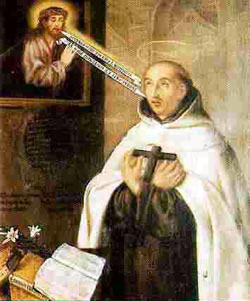
St. John of the Cross is accredited with exploring The Dark Night of the Soul. The use of darkness in his thought represents a type of purity, a sensual finality which the senses cease to engage reality. In his prequel Ascent of Mount Carmel St. John speaks of the movement from meditating on things to the greater goal of spiritual contemplation which does engage objects of imagination. When a person enters into this movement of contemplation the experience will appear to be one of void and obscurity. There is lack of clarity in purity (at least in our experience of it). St. John offers this example to explain.
If we consider a ray of sunlight entering through a window, we see that, the more the said ray is charged with atoms and particles of matter, the more palpable, visible and bright it appears to the eye of sense; yet it is clear that the ray is in itself least pure, clear, simple and perfect at that time, since it is full of so many particles and atoms. And we likewise that, when it is purest and freest from those particles and atoms, the least palpable and the darkest does it appear to the material eye; and the purer it is, the darker and less apprehensible it appears to it. And if the ray were completely pure and free from all these atoms and particles, even from the minutest specks of dust, it would appear completely dark and invisible to the eye, since everything that could be seen would be absent from it - namely the objects of sight. For the eye would find no objects whereon to rest, since light is no proper object of vision.
This reminded me in part of my recent reading of Evagrius of Pontus. Evagrius addresses the demons that attack the soul and manifest themselves in one of the Eight Deadly Thoughts. These demons are not a homogeneous mass of bullies trying to get you to smoke up or trip some old lady. I see them perhaps not unlike the spirit of modern of criticism (give me a minute to unpack this). Modern criticism is relentless in its pursuit of exposure. If there is instability in a given structure then criticism is that tool which will expose it. This too is the swarming of demons who expose the vices of a given subject whether it is through "shameful acts" or the conceit of pride. Listen to how Evagrius describes the work of demons.
The more the soul progresses, the greater are the antagonists that follow it in succession, for I am not convinced that it is always the same demons that persist against it. They know this best who perceive the temptations with greater precision and who see the impassibility they have attained being dislodged by the successive demons.
Impassibility is one of the main goals for the monk. This would in essence reflect a "perfect structure" in which no weakness is exposed. The demons constantly work to dislodge the monk's perceived stability. Perhaps simplistically this reflects a major stream of criticism at least since Descartes. The challenge of course comes in what to do with the exposed weaknesses. I still get the sense that many theorists assume that the work of rigorous criticism is in itself the development of good theory or practice. But here criticism is insatiable and if it is satiated then this likely means that the theory has been stripped of any nutritional value. St. John and Evagrius conceive of another movement. I have normally understood impassibility in a very negative light. To be impassible is to be unfeeling, disengaged staring glassy eyed out into the void. What I am beginning to understand is that these monks do in fact believe that ultimately their bodies are perfect structures. This is not like the theorists hope that criticism will leave that which is pure. The structure rather is pure in its suitability for spirit and love. The demonic, like criticism, reveals where those movements are impeded.
Evagrius again,
Love is the offspring of impassibility, and impassibility is the blossom of the practical life.
I think I should probably end it here for now, this is all getting pretty sketchy. Hopefully something a little more coherent can follow.
Friday, September 28, 2007
A Fertile Absence
Now and again I have been turning to the writings of Evagrius of Pontus who lived in the fourth century. He is credited for having collected or articulated the Eight Deadly Thoughts (long before the Seven Deadly Sins took prominence). I was intrigued by the opening lines for the first two "thoughts" Gluttony and Fornication.
He begins on Gluttony,

Abstinence is the origin of fruitfulness, the blossom and beginning of the practical life.
Then on Fornication he begins,
Abstinence gives birth to chastity.
These statements struck me first as counter-intuitive (at least to most contemporary sensibilities) and second as having a certain ontological importance. There are means and resources which the individual and social can draw on that are not easily perceptible. We show great admiration for those who can live a life of voluntary poverty but do not embrace the underlying ontology that informs it. The word "abstinence" in our vernacular evokes images barrenness, repression and sterility. It should be re-endowed with the fecundity that is latent in it.
In his treatise against "boredom" Kierkegaard writes of the principle of "limitation" as "the only saving principle in the world". In offering a variety of examples he comes clearly to the maxim that "the more you limit yourself, the more fertile you become in invention." We equate fertility with its "fruit" its end product and not so much its actuality which is ironically its potentiality, its ready absence.
This feeds into my overall thoughts on aesthetics as the sensing of possibility and the allowing of its birth and also the role that absence (often articulated as the sacred) plays in conception. This is of course part of a monastic culture only tangentially observable in our culture but worth greater consideration.
