Showing posts with label monasticism. Show all posts

Friday, May 14, 2010

Peace and Clean Floors


Salem at the Carmelite Monestary in Niagara Falls.
People go to stay in the guest houses of monasteries and convents (in surprisingly large numbers) to absorb an atmosphere of 'peace'; it is a break from the conflict and tension, a move into another world from which strain is supposedly absent. The world of the cloister is one in which some new level of awareness has been attained, and its inhabitants breathe a different air. And we less fortunate (or less committed), are briefly admitted into it, for our nourishment and refreshment.
. . .
The popular concept of the peace of the cloister, like the glib misunderstandings of the Buddha's contemplation, is a damaging error - damaging of the people who hold it, damaging to those onto whom it is projected. It encourages most of us to think of peace as something intrinsically separate from the hard and familiar world, something we cannot expect to see realized in most of the reality we know: and it demands the impossible from the cloister, increasing tenfold the real and heavy pressures of that life.
. . .
God's peace has something to do with an acceptance of God's world in its complexity.
This is taken from Rowan Williams' The Truce of God. Whenever I am in one of those 'peaceful places' like the image above I tend to look at the floors and see how clean they are. Floors that clean do not come from a natural spirituality. The peace that comes in being able to perform that duty and create that space is a hard fought peace indeed always on the verge of descent.
I had not read anything by Williams in a while. This little book is a good reminder of his basic premise that heresy is the tendency towards simplification.

Read More...

Friday, October 05, 2007

The Spirt/Demon of Modern Criticism and the Search for a Perfect Structure


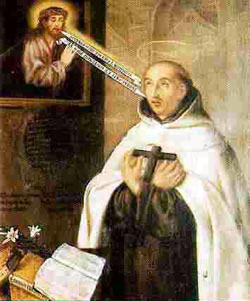
St. John of the Cross is accredited with exploring The Dark Night of the Soul. The use of darkness in his thought represents a type of purity, a sensual finality which the senses cease to engage reality. In his prequel Ascent of Mount Carmel St. John speaks of the movement from meditating on things to the greater goal of spiritual contemplation which does engage objects of imagination. When a person enters into this movement of contemplation the experience will appear to be one of void and obscurity. There is lack of clarity in purity (at least in our experience of it). St. John offers this example to explain.


If we consider a ray of sunlight entering through a window, we see that, the more the said ray is charged with atoms and particles of matter, the more palpable, visible and bright it appears to the eye of sense; yet it is clear that the ray is in itself least pure, clear, simple and perfect at that time, since it is full of so many particles and atoms. And we likewise that, when it is purest and freest from those particles and atoms, the least palpable and the darkest does it appear to the material eye; and the purer it is, the darker and less apprehensible it appears to it. And if the ray were completely pure and free from all these atoms and particles, even from the minutest specks of dust, it would appear completely dark and invisible to the eye, since everything that could be seen would be absent from it - namely the objects of sight. For the eye would find no objects whereon to rest, since light is no proper object of vision.


This reminded me in part of my recent reading of Evagrius of Pontus. Evagrius addresses the demons that attack the soul and manifest themselves in one of the Eight Deadly Thoughts. These demons are not a homogeneous mass of bullies trying to get you to smoke up or trip some old lady. I see them perhaps not unlike the spirit of modern of criticism (give me a minute to unpack this). Modern criticism is relentless in its pursuit of exposure. If there is instability in a given structure then criticism is that tool which will expose it. This too is the swarming of demons who expose the vices of a given subject whether it is through "shameful acts" or the conceit of pride. Listen to how Evagrius describes the work of demons.

The more the soul progresses, the greater are the antagonists that follow it in succession, for I am not convinced that it is always the same demons that persist against it. They know this best who perceive the temptations with greater precision and who see the impassibility they have attained being dislodged by the successive demons.


Impassibility is one of the main goals for the monk. This would in essence reflect a "perfect structure" in which no weakness is exposed. The demons constantly work to dislodge the monk's perceived stability. Perhaps simplistically this reflects a major stream of criticism at least since Descartes. The challenge of course comes in what to do with the exposed weaknesses. I still get the sense that many theorists assume that the work of rigorous criticism is in itself the development of good theory or practice. But here criticism is insatiable and if it is satiated then this likely means that the theory has been stripped of any nutritional value. St. John and Evagrius conceive of another movement. I have normally understood impassibility in a very negative light. To be impassible is to be unfeeling, disengaged staring glassy eyed out into the void. What I am beginning to understand is that these monks do in fact believe that ultimately their bodies are perfect structures. This is not like the theorists hope that criticism will leave that which is pure. The structure rather is pure in its suitability for spirit and love. The demonic, like criticism, reveals where those movements are impeded.
Evagrius again,
Love is the offspring of impassibility, and impassibility is the blossom of the practical life.

I think I should probably end it here for now, this is all getting pretty sketchy. Hopefully something a little more coherent can follow.

Read More...

Friday, September 28, 2007

A Fertile Absence


Now and again I have been turning to the writings of Evagrius of Pontus who lived in the fourth century. He is credited for having collected or articulated the Eight Deadly Thoughts (long before the Seven Deadly Sins took prominence). I was intrigued by the opening lines for the first two "thoughts" Gluttony and Fornication.
He begins on Gluttony,

Abstinence is the origin of fruitfulness, the blossom and beginning of the practical life.

Then on Fornication he begins,
Abstinence gives birth to chastity.

These statements struck me first as counter-intuitive (at least to most contemporary sensibilities) and second as having a certain ontological importance. There are means and resources which the individual and social can draw on that are not easily perceptible. We show great admiration for those who can live a life of voluntary poverty but do not embrace the underlying ontology that informs it. The word "abstinence" in our vernacular evokes images barrenness, repression and sterility. It should be re-endowed with the fecundity that is latent in it.
In his treatise against "boredom" Kierkegaard writes of the principle of "limitation" as "the only saving principle in the world". In offering a variety of examples he comes clearly to the maxim that "the more you limit yourself, the more fertile you become in invention." We equate fertility with its "fruit" its end product and not so much its actuality which is ironically its potentiality, its ready absence.
This feeds into my overall thoughts on aesthetics as the sensing of possibility and the allowing of its birth and also the role that absence (often articulated as the sacred) plays in conception. This is of course part of a monastic culture only tangentially observable in our culture but worth greater consideration.

Read More...

Friday, September 14, 2007

Bearing Life

Having read the recent post at Rough Theory I am offering this for consideration. I tend not to work in the specific arena of gender but I was editing a earlier post and was reflecting on the usefulness or value of gender specific (though perhaps not biologically specific) language in the service of theory and reflection.

Please comment and criticize as needed. I understand that for some of you my initial "religious" context may already be an issue (though I would continue to contend for its conceptual significance).
-
-
Nathaniel Hawthorn’s The Scarlet Letter traces the movements of conception, gestation and birth. The setting of the story is the seventeenth century in a Puritan community in New England. A newcomer, Hester Prynne has an affair with the local minister Arthur Dimmesdale. Only Hester is charged with adultery because she becomes pregnant before her husband arrives from Europe (the townspeople put two and two together). The identity of her lover, however, remains unknown to the community. In judgment on Hester the community orders that she wear a scarlet letter “A” on her chest.

In Hester Prynne the physical body carries and births their act of passion. In Rev. Dimmesdale, however, their action finds no transformative womb as is found for Hester in the birth of Pearl. In the man all remains buried and cancerous in the heart. Hester continues to live with her act through her child and on her chest. And here too the judgment of the Scarlet Letter ultimately finds fertile soil. She is drawn inward judged by the world and by herself for seven years. In those seven years we read about a “new purity” that replaces what was lost. Hester emerges, made strong by the “stern and wild” teachers of shame, despair and solitude.

Arthur is only weakened. Though he finds greater communion with the sin of the world with no child and no letter Arthur remains the model of fierce righteous preservation. Arthur has no space for conception. Historically men have received or accepted few spaces for their “sin” to be transformed, to conceive new life. Men have worked externally entrenching laws and erecting towers. What women have not already naturally bore in their bodies men have imposed on their bodies. They have carried for many the long road of transformation and new birth. It is perhaps only the monks in their cells who have hoped to find a womb from which to heal their soul.

Is more attention needed towards the historically feminine aspect of bearing?
Mother Mary bore the Messiah within her womb and she also pondered within her heart. Hester and Mary are structurally made with cells that monks seek to reside. Intellectually this carried into a reflective nature which growth and substantive expression. We find the spiritual dimension of this perhaps most fully developed in Teresa of Avila’s exploration of her Interior Castle.
In her opening discourse she writes,


I thought of the soul as resembling a castle, formed of a single diamond or a very transparent crystal, and containing many rooms, just as in heaven there are many mansions. If we reflect, sisters, we shall see that the soul of the just man is but a paradise, in which, God tells us, He takes His delight.
Let us imagine, as I said, that there are many rooms in this castle, of which some are above, some below, others at the side; in the centre, in the very midst of them all, is the principal chamber in which God and the soul hold their most secret intercourse.


Listen then to how a man, St. John of the Cross in his Ascent of Mount Carmel, sets out on his path of communion with God.

Wherein the soul sings of the happy chance which it had in passing through the dark night of faith, in detachment and purgation of itself, to union with the Beloved.

On a dark night, Kindled in love with yearnings — oh, happy chance! —
I went forth without being observed, My house being now at rest.

In darkness and secure, By the secret ladder, disguised — oh, happy chance! —
In darkness and in concealment, My house being now at rest.

In the happy night, In secret, when none saw me,
Nor I beheld aught, Without light or guide, save that which burned in my heart.


There is of course much that overlaps the two writers but the initial images are striking. Teresa understands implicitly that she carries a space to bear communion with God and life. John of the Cross must flee in the night to find his lover. The imagery is darkness, dislocation and passion. Though John experiences this as joy it is often not a well understood and potentially dangerous combination. There is a type of homelessness that many struggle with. This is perhaps a historically masculine experience (though of course unprejudiced in its specific expression). As I just alluded to there remains a volatile and often violent intersection of love and hate in the masculine desire for the feminine (or however one might characterize that communion). This is the rage against not having a home and not knowing how to be received as a guest (or lover). So there remains the siege of borders and staking claims though internally (and existentially) all remains in strife (I am thinking now of my recent viewing of Platoon and the internal vs. external strife explored there). There must first be a peace, and intimate communion apart from (and perhaps sometimes in response to) the judgment of the world. As Hester understood we cannot overcome the world in judgment. There must first be an acknowledgement of the home that is us and acceptance that we may be received as guests. And possibly the hope that new life is possible.

Read More...