
I sent my review of The End of Religion to the author Bruxy Cavey and received a prompt and detailed response. I thought it would be helpful working through those points before shipping the Review off to Canadian Mennonite.
Cavey begins with the most important response stating,I believe that understanding the target audience for my book helps clarify many things, which you have not mentioned in your review. The End of Religion is written primarily to non-Christians who could be described as religion drop-outs - people who are open to "faith" (whatever they mean by that), but would tell you (often in impassioned and colourful language) that they have a negative take on organized "religion". From that starting point I want to engage these readers in a "from here to there" journey toward the biblical Jesus and New Testament community. I believe I state this clearly at the start of the book and follow this approach throughout. . . .
So this book is my attempt to describe the biblical gospel in language these people might have ears to hear. If I were writing a book to a primarily Christian audience my approach may be very different. I see the approach I take in The End of Religion as comparable to the Apostle Paul's communication style in Acts 17, communicating the message of Jesus in words and images that beckons his pagan audience to go further in their investigation of Christ. No doubt he would phrase his teaching very differently if he were writing to a Christian audience (for instance, the New Testament demonstrates that Paul is not in the habit of quoting pagan sources in place of Scripture and calling all people, whether believer or not, "God's children").
I trust that if you read The End of Religion keeping in mind that you are eavesdropping on a conversation between me and a specific target reader - one who comes to the table with baggage that they need help putting down - it will go a long way to clarifying why I take the approach I take and emphasise the things I do.
The claim is that because Cavey is writing to a non-Christian audience the approach will be different. As I mentioned in my review I get the impression that for Cavey 'Christians' are stuffy old fuddy-duddies blinded by the lure tradition. But to these people I suspect he would want to bring the same message. In addition the lecture I heard at a Christian event ten years was also in the same medium. Perhaps he was unconcerned with those who already had a meaningful religious expression. I agree that when I teach Sunday School for 10 year olds and when I prepare a college lecture I will be using a different vocabularly and syntax. In the case of Cavey however, I see his medium and message so intricately tied together that I am not convinced he is interested in articulating the Gospel in any other way (though I have not heard his church teaching), which of course is fine only that his comment does not apply to my criticisms. I guess I am simply not sure why this would not be the same message preached to the church, because according to the book, the church sure needs it!
In my review I viewed Cavey's work as inappropriately seperating himself from church history. In response he says that he is interested in responding to the cynic who stumbles over the atrocities that the church has perpetrated and that he does acknowledge "that Christians are responsible for many wonderful examples of charity and benevolence through the centuries. But these positive examples cannot nor should not undo the repulsive effects of the judgmental bigotry and horrific violence that permeates church history" (58). It is fine to have that caveat but then it would be important to state that the chapter is dealing with a particular aspect of church history, as opposed to a near blanket statement. And this chapter would then be even more palatable if there were any sense that Cavey was interested in drawing from the wells of church history (other than the quotes that preface some of the chapters). The way Cavey overcomes the challenge of church history is seperate himself from it. My concern is that if the reader accepts Cavey's basic positions how could they then not also be swayed into thinking that Cavey's expression of irreligion is the climax (or return) of true Christian spirituality. Cavey explicitly acknowledges that his work is within the stream of evangelical/Anabaptist. I suppose it is the tendency of working within this stream to not elevate the role of church history and tradition. This, however, makes it no less of historical religious expression.
In my review I stated that Cavey's book led towards an individualistic 'me and Jesus' view of spirituality. Cavey responded by saying that in the end of the book the final thing the reader is encouraged to do is seek out intentional community (230). In reviewing the book I can more understand the role he gives for the community of believers. For instance baptism is a sign of the iniatition into a community and not just a personal experience of forgiveness. Communion, however, appears to have a much lower view of community. There is neither the act of economic distribution emphasized in Anbaptism nor the communal formation emphasized in more mainline traditions. It is rather a replacement of the the sacrifice for the individuals forgiveness. I understand that Cavey emphasizes the need for community I just find it in the end subordinated to the role of the individual in his overall work.
Finally, Cavey feels as though I have misunderstood and so misrepresented his intention for 'organized irreligion' which is what he sees as the natural expression flowing from the Gospel. I appreciate that his book is an attempt at helping people to take the next (or first) step in their faith. And I was almost ready to admit that I was in fact very wrong in how I understood his intention but then he made this strange statement, "I can only leave you to draw your own conclusion about the theology of The End of Religion, and certainly no human effort to communicate the gospel of Jesus is necessary. God doesn't need us - we need him." This I assume is in response to my statement that indeed we need to rely on the things Cavey rejects because they are the realities of life. Indeed they are God's medium as God was the one who came as the word. This is I suppose what I can't get around. All of these things, all of these things of faith are ultimately wedded in the material world. I never said God needed us and yes we need God, we need all that God offers us.
Cavey asks in his book that I do not get caught up in semantics. That I look to the essence of his message. But semantics are indeed part of the message. Yes many have come and found this message attractive (and I find hard to argue with a transformed life) and many others have found their way out the backdoor of similar 'emergent' expressions. So as Cavey asks in his book, So What? I suppose each should be convinced in their own minds and may any friction add to a fire that warms, illuminates, and purges.
Friday, September 05, 2008
Cracking the Cavey Code

Thursday, September 04, 2008
Proclaiming the End: A Review of Bruxy Cavey's The End of Religion
I will admit that I was prepared to hate Bruxy Cavey’s recent book The End of Religion: Encountering the Subversive Spirituality of Jesus. I can still vividly remember Cavey speaking at my college about ten years ago. The first words of his lecture were, “God hates religion!” I was put off by his rhetorical style and it left a bad taste in my mouth since. When there was a chance to review his book I jumped at it to see how his message had developed. Cavey divides his book into three parts. The first part explores the inadequacy of religion and its negative effects throughout history. Second Cavey looks at the scandalous life of Jesus as he attempts to recover the subversive nature of his message. Finally, Cavey draws the implications Jesus’ message should have on the life of those who follow him.

Friday, July 25, 2008
Out on the Streets
As I mentioned I have been on holidays and tomorrow I will be trying something new. I will be walking to my nearest city, the great twin city Kitchener-Waterloo. The walk will be about 25 km of beautiful rolling countryside. Then I will be spending the night on the mean streets of downtown Kitchener living by my wits. I have always wanted to spend a night on the street. I don't think this desire is in any way condescending or at least more condescending than most other desires. I just sort of want to. I tried doing it one time in Winnipeg about 10 years ago and always got to freaked out by the noises around me when I was trying to fall asleep. We'll see what will happen this time. I have also never gone for such a long walk and am considering it a type of experimental pilgrimage. I think there is a lot of potential for local pilgrimages. I am hoping to eventually to a 3-4 day pilgrimage to Toronto. There are incredible natural, urban and industrial areas in that stretch to reflect on and pray over. I do not pray very well and consider intentional walking a form of prayer.
See you in a couple of days . . . hopefully!
Sunday, November 11, 2007
Proust, Prayer and Memory
In his classic work on Prayer Evagrius of Pontus writes,
"When you are praying the memory brings before you either fantasies of objects from the past, or recent concerns, or the face of one who has caused you hurt."
It is well known (or at least popular history) that the final years of Proust's life were spent largely in a sound proof room in Paris where he wrote at night and slept during the day. Here he completed his metanarrative À la recherche du temps perdu (In Search of Lost Time). I am in the final stages of reading the first of the seven volume literary cosmos Swann's Way.
Swann's Way is a meditation on memory and the sublime. Under Proust's pen every instant (every memory) is infinite. In his secluded final years memory dominated him as he wrestled with the faces of love and hurt in his monastic cell. And it was two faces that emerged; one was a young boy's mother in first half of the book and other being M. Swann's lover Odette in the second half.
I read both relationships as exploring the basic human sense of insufficiency. Being alone with your self stands as a terrifying prospect for most individuals. I am not referring to being by yourself but being alone with yourself; to travel inward and commune with what you encounter. This was Proust's journey and as Evagrius points out when you travel inward (typical language for the movement of prayer) you will encounter memory and you will encounter the wound that drives our compulsions. The beauty of Proust's life and work (as I limitedly understand it) is that this movement and intentional uncovering was his healing as his life reflects a solitary communion with self. What Proust offers us is a vision of how attentiveness in life (again typical language of contemplative prayer) opens the gratuitous (infinite?) reality of life. This did not come from fleeing his wound but allowing it to be a generative place in his thought.
Proust entertains only a sort of contemplative memory. As he begins to enter his childhood experience he realizes that he could indeed recall more factual memories of his life in Combray but these came through "an exercise of the will", his "intellectual memory". Here again we hear mystic imagery. St. John of the Cross distinguishes sharply between meditation and contemplation. We can do meditation but not so with contemplation. Contemplation is a state of reception. Proust speaks of 'willful' memory in this way.
"The pictures which that kind of memory shows us of the past preserve nothing of the past itself, I should never have had any wish to ponder over this residue of Combray. To me it was in reality all dead. Permanently dead? Very possibly."
Proust is interested in living memory. This is not the end of a posture of contemplative prayer but it is the path. I will post shortly exploring Proust's most famous passage on 'living memory'.

Friday, October 05, 2007
The Spirt/Demon of Modern Criticism and the Search for a Perfect Structure
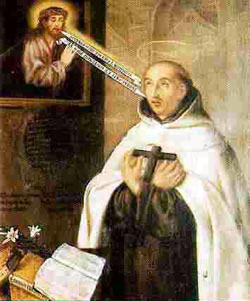
St. John of the Cross is accredited with exploring The Dark Night of the Soul. The use of darkness in his thought represents a type of purity, a sensual finality which the senses cease to engage reality. In his prequel Ascent of Mount Carmel St. John speaks of the movement from meditating on things to the greater goal of spiritual contemplation which does engage objects of imagination. When a person enters into this movement of contemplation the experience will appear to be one of void and obscurity. There is lack of clarity in purity (at least in our experience of it). St. John offers this example to explain.
If we consider a ray of sunlight entering through a window, we see that, the more the said ray is charged with atoms and particles of matter, the more palpable, visible and bright it appears to the eye of sense; yet it is clear that the ray is in itself least pure, clear, simple and perfect at that time, since it is full of so many particles and atoms. And we likewise that, when it is purest and freest from those particles and atoms, the least palpable and the darkest does it appear to the material eye; and the purer it is, the darker and less apprehensible it appears to it. And if the ray were completely pure and free from all these atoms and particles, even from the minutest specks of dust, it would appear completely dark and invisible to the eye, since everything that could be seen would be absent from it - namely the objects of sight. For the eye would find no objects whereon to rest, since light is no proper object of vision.
This reminded me in part of my recent reading of Evagrius of Pontus. Evagrius addresses the demons that attack the soul and manifest themselves in one of the Eight Deadly Thoughts. These demons are not a homogeneous mass of bullies trying to get you to smoke up or trip some old lady. I see them perhaps not unlike the spirit of modern of criticism (give me a minute to unpack this). Modern criticism is relentless in its pursuit of exposure. If there is instability in a given structure then criticism is that tool which will expose it. This too is the swarming of demons who expose the vices of a given subject whether it is through "shameful acts" or the conceit of pride. Listen to how Evagrius describes the work of demons.
The more the soul progresses, the greater are the antagonists that follow it in succession, for I am not convinced that it is always the same demons that persist against it. They know this best who perceive the temptations with greater precision and who see the impassibility they have attained being dislodged by the successive demons.
Impassibility is one of the main goals for the monk. This would in essence reflect a "perfect structure" in which no weakness is exposed. The demons constantly work to dislodge the monk's perceived stability. Perhaps simplistically this reflects a major stream of criticism at least since Descartes. The challenge of course comes in what to do with the exposed weaknesses. I still get the sense that many theorists assume that the work of rigorous criticism is in itself the development of good theory or practice. But here criticism is insatiable and if it is satiated then this likely means that the theory has been stripped of any nutritional value. St. John and Evagrius conceive of another movement. I have normally understood impassibility in a very negative light. To be impassible is to be unfeeling, disengaged staring glassy eyed out into the void. What I am beginning to understand is that these monks do in fact believe that ultimately their bodies are perfect structures. This is not like the theorists hope that criticism will leave that which is pure. The structure rather is pure in its suitability for spirit and love. The demonic, like criticism, reveals where those movements are impeded.
Evagrius again,
Love is the offspring of impassibility, and impassibility is the blossom of the practical life.
I think I should probably end it here for now, this is all getting pretty sketchy. Hopefully something a little more coherent can follow.
Thursday, September 27, 2007
Letter 10 - Rilke, Art and Life
This is the final paragraph in the last letter that Rilke wrote to Franz Kappus,
Art too is only a way of living, and, however one lives, one can, unwittingly, prepare oneself for it; in all that is real one is closer to it and more nearly neighbored than in the unreal half-artistic professions, which, while they pretend proximity to some art, in practice belie and assail the existence of all art, as for instance the whole of journalism does and almost all criticism and three-quarters of what is called and wants to be called literature. I am glad, in a word, that you have surmounted the danger of falling into this sort of thing and are somewhere in a rough reality being solitary and courageous. May the year that is at hand uphold and strengthen you in that.
I suspect that most of us with some appreciation towards the arts feel a little sting in Rilke's parting words. I also suspect that Rilke is not interested in criticizing professions as such but in criticizing those who "pretend proximity". Nature, reality and truth will not be fooled. Rilke believes that they can be trusted, but this in turn means that they must be trusted. We cannot fool or manipulate art and beauty. Proximity and presence is key both to the formation of identity and to the healthy relationships with others. Rilke's call inward demands that we begin analyzing or most primal walls, those interior walls that divide our passions, goals and compulsions. What have ghettoized in our self? What is it in us that remains hermetically sealed? This movement is necessary first because it in turn affects our external sensual reality. In greater self-understanding we develop courage and stability to allow ourselves to "presence" reality and not pretend proximity. There is no peer review here that can validate our interior and the movement is not natural. Much of Rilke's admonishing focuses around receiving the difficult. This can of course be reduced to pathology and veiled masochism, but this is not truly difficult. The relationship between presence and difficulty is key here. To experience presence we need identify particular dividing walls and either dismantle or at least gate them. Walls, however, are the very essence of our grasp for control and power. To take down a wall is contrary to the nature individual self-preservation, or at the very least it is an act of trust beyond one's self. The movement of difficulty is the movement of de-centralizing a personal position of power. This however, is also the movement and possibility of presence, even communion.
Friday, September 14, 2007
Bearing Life
Having read the recent post at Rough Theory I am offering this for consideration. I tend not to work in the specific arena of gender but I was editing a earlier post and was reflecting on the usefulness or value of gender specific (though perhaps not biologically specific) language in the service of theory and reflection.
Please comment and criticize as needed. I understand that for some of you my initial "religious" context may already be an issue (though I would continue to contend for its conceptual significance).
-
-
Nathaniel Hawthorn’s The Scarlet Letter traces the movements of conception, gestation and birth. The setting of the story is the seventeenth century in a Puritan community in New England. A newcomer, Hester Prynne has an affair with the local minister Arthur Dimmesdale. Only Hester is charged with adultery because she becomes pregnant before her husband arrives from Europe (the townspeople put two and two together). The identity of her lover, however, remains unknown to the community. In judgment on Hester the community orders that she wear a scarlet letter “A” on her chest.
In Hester Prynne the physical body carries and births their act of passion. In Rev. Dimmesdale, however, their action finds no transformative womb as is found for Hester in the birth of Pearl. In the man all remains buried and cancerous in the heart. Hester continues to live with her act through her child and on her chest. And here too the judgment of the Scarlet Letter ultimately finds fertile soil. She is drawn inward judged by the world and by herself for seven years. In those seven years we read about a “new purity” that replaces what was lost. Hester emerges, made strong by the “stern and wild” teachers of shame, despair and solitude.
Arthur is only weakened. Though he finds greater communion with the sin of the world with no child and no letter Arthur remains the model of fierce righteous preservation. Arthur has no space for conception. Historically men have received or accepted few spaces for their “sin” to be transformed, to conceive new life. Men have worked externally entrenching laws and erecting towers. What women have not already naturally bore in their bodies men have imposed on their bodies. They have carried for many the long road of transformation and new birth. It is perhaps only the monks in their cells who have hoped to find a womb from which to heal their soul.
Is more attention needed towards the historically feminine aspect of bearing?
Mother Mary bore the Messiah within her womb and she also pondered within her heart. Hester and Mary are structurally made with cells that monks seek to reside. Intellectually this carried into a reflective nature which growth and substantive expression. We find the spiritual dimension of this perhaps most fully developed in Teresa of Avila’s exploration of her Interior Castle.
In her opening discourse she writes,
I thought of the soul as resembling a castle, formed of a single diamond or a very transparent crystal, and containing many rooms, just as in heaven there are many mansions. If we reflect, sisters, we shall see that the soul of the just man is but a paradise, in which, God tells us, He takes His delight.
Let us imagine, as I said, that there are many rooms in this castle, of which some are above, some below, others at the side; in the centre, in the very midst of them all, is the principal chamber in which God and the soul hold their most secret intercourse.
Listen then to how a man, St. John of the Cross in his Ascent of Mount Carmel, sets out on his path of communion with God.
Wherein the soul sings of the happy chance which it had in passing through the dark night of faith, in detachment and purgation of itself, to union with the Beloved.
On a dark night, Kindled in love with yearnings — oh, happy chance! —
I went forth without being observed, My house being now at rest.
In darkness and secure, By the secret ladder, disguised — oh, happy chance! —
In darkness and in concealment, My house being now at rest.
In the happy night, In secret, when none saw me,
Nor I beheld aught, Without light or guide, save that which burned in my heart.
There is of course much that overlaps the two writers but the initial images are striking. Teresa understands implicitly that she carries a space to bear communion with God and life. John of the Cross must flee in the night to find his lover. The imagery is darkness, dislocation and passion. Though John experiences this as joy it is often not a well understood and potentially dangerous combination. There is a type of homelessness that many struggle with. This is perhaps a historically masculine experience (though of course unprejudiced in its specific expression). As I just alluded to there remains a volatile and often violent intersection of love and hate in the masculine desire for the feminine (or however one might characterize that communion). This is the rage against not having a home and not knowing how to be received as a guest (or lover). So there remains the siege of borders and staking claims though internally (and existentially) all remains in strife (I am thinking now of my recent viewing of Platoon and the internal vs. external strife explored there). There must first be a peace, and intimate communion apart from (and perhaps sometimes in response to) the judgment of the world. As Hester understood we cannot overcome the world in judgment. There must first be an acknowledgement of the home that is us and acceptance that we may be received as guests. And possibly the hope that new life is possible.
Wednesday, August 29, 2007
Rilke - Letter 3: Part II
Rilke offers interesting commentary on art, sexuality and gender. Though many comparisons exist between the birthing process of human life and of art Rilke encourages further that the artist offer the truly human in the artistic process. In this letter Rilke refers to the poet Richard Dehmel as one who writes in heat. He acknowledges that such writing indeed moves him, that Dehmel’s “poetic power is great, strong as a primitive instinct; it has its own unyielding rhythms in itself and breaks out of him as out of mountains.” But he continues to say that, “this power is not always honest.” Rilke claims that Dehmel’s artistic urge as “it comes to the sexual” does not find a “clean” sex world, that is it is not sufficiently human.
“[It] is only male, is heat, intoxication and restlessness, and laden with the old prejudices and arrogances with which man has disfigured and burdened love. Because he loves as man only, not as human being, for this reason there is in his sexual feeling something narrow, seeming wild, spiteful, time-bound, uneternal, that diminishes his art and makes it ambiguous and doubtful. It is not immaculate, it is marked by time and by passion, and little of it will survive and endure. (But most art is like that!) Nevertheless one may deeply rejoice in what there is of greatness in it, only one must not lost oneself in it.”
In the realm of art and beauty categories of male and female carry significant currency. In earlier posts I reflected on the role the feminine womb or interior played in spiritual formation. Here Rilke warns of the heat and restlessness of the masculine. It is receiving the artistic urge “in community,” in the “clean” sex world of the human that abiding beauty emerges. I am intrigued by Rilke’s notion of a “clean sex world”. This image both evokes and distances itself from cultic representations of the sacred in the Hebrew Bible. Having sex rendered one ceremonially unclean and required a distancing from the holiness of God. However, the union between God and humanity is often rendered in sexual terms. As with Rilke this too is conceived of as a (ceremonially) “clean sex world”. In the New Testament this would be expressed with the image of “the pure spotless bride”. In the Bible as with Rilke this union emerges only in trust and humility. In the Bible this is conceived in the act and life of worship for Rilke this is conceived in the space within and beyond ourselves (trust), “in the dark, in the inexpressible, the unconscious, beyond the reach of one’s own intelligence.” In this space the artist is called to “await with deep humility and patience the birth-hour of a new clarity.”
Saturday, August 18, 2007
The Space of Life II

In Hester Prynne the body carries and births the desire of the soul and act of the flesh. In Rev. Dimmesdale all remains buried and cancerous in the heart. Hester continues to live with her act through her child and on her chest. She is drawn inward judged by world and by herself for seven years. She offers only acts of survival and charity. She is emerging to me as one of the clearest examples of Protestant monasticism. Rev. Dimmesdale remains the model of fierce righteous preservation. He is the priest offering strange fire on the alter.
I am noticing more and more the aspect of feminine bearing.
Mother Mary bore the Messiah within her womb and pondered within her heart. Hester and Mary are structurally made with cells that monks seek to reside. Teresa of Avila is able to explore her Interior Castle.
In her opening discourse she writes,
I thought of the soul as resembling a castle, formed of a single diamond or a very transparent crystal, and containing many rooms, just as in heaven there are many mansions. If we reflect, sisters, we shall see that the soul of the just man is but a paradise, in which, God tells us, He takes His delight.
Let us imagine, as I said, that there are many rooms in this castle, of which some are above, some below, others at the side; in the centre, in the very midst of them all, is the principal chamber in which God and the soul hold their most secret intercourse.
Listen then to how St. John of the Cross in his Ascent of Mount Carmel sets out on his path of communion with God.
Wherein the soul sings of the happy chance which it had in passing through the dark night of faith, in detachment and purgation of itself, to union with the Beloved.
On a dark night, Kindled in love with yearnings — oh, happy chance! —
I went forth without being observed, My house being now at rest.
In darkness and secure, By the secret ladder, disguised — oh, happy chance! —
In darkness and in concealment, My house being now at rest.
In the happy night, In secret, when none saw me,
Nor I beheld aught, Without light or guide, save that which burned in my heart.
There is of course much that overlaps between the two writers but the initial images are striking. Teresa understands implicitly that she carries a space to bear communion with God. John of the Cross must flee in the night to find his lover. I think these images offer great insight into reflections on gender and homelessness/homecoming.
Tuesday, August 07, 2007
The Space of Life
Willem immediately understood what he heard. The sentences were few and simple but it was only later that night that their significance began to well up in his heart overflowing into his body and mind. It was as though knowledge or perhaps truth or whatever it is that words can carry actually had weight to it. It pressed him down on the rustled sheets of his bed. Then as though his nose were too heavy to be held upright his head slowly fell to his left and turned towards the window where he caught the light the moon. The moonlight held his gaze and he lay there motionless drifting away from what he was coming to realize. A slight kink in his neck broke the trance and he tilted his head slightly to stretch it out. With his head now facing the window at a new angle the moon somehow looked different. Willem sat up in bed and broke the silence by something between a laugh and sigh. The window was open at an angle and the moon that he saw was only a reflection. . . . The moon was not there. He took heart and almost allowed a smile. What he thought he had was no longer his. His life was not his own. His life was at the mercy of . . . what? He wondered what exactly was holding him together?
Enter through the narrow gate. For wide is the gate and broad is the road that leads to destruction, and many enter through it. But small is the gate and narrow the road that leads to life, and only a few find it.
In taking the narrow way . . . there is room only for self-denial, and the Cross, which is the staff by which one may reach one’s goal, and whereby the road is greatly lightened and made easy. . . . For if anyone resolves to submit themselves to carrying this cross – that is to say, if they resolve to desire in truth to meet trials and to bear them in all things for God’s sake, they will find in them all great relief and sweetness that they may travel upon this road, detached from all things and desiring nothing. However, if they desire to possess anything – whether it come from God or from any other source – with any feeling of attachment, they have not stripped and denied themselves in all things; and thus they will be unable to walk along this narrow path. . . . I would then convince spiritual persons that this road to God consists not in a multiplicity of meditations nor in ways or methods of such . . . but that it consists only in the one thing that is needful, which is the ability to deny oneself truly, according to that which is without and that which is within.
- St. John of the Cross
Enter through the narrow gate. For wide is the gate and broad is the road that leads to destruction, and many enter through it. But small is the gate and narrow the road that leads to life, and only a few find it.
And so we enter the tight and constricted space with the jagged pressures of distress and chaos. But once inside there is the promise of transformation, the sweetness of the Cross described above. And in time our breathing that was once anxious and short in this tight space will grow deeper and more relaxed and the space that felt so confining will take on the smooth and supportive contours of a mother’s womb waiting to birth new life.
- Sermon August 5th
Thursday, June 28, 2007
The Road Less Travelled
I recently stumbled across this picture. It is a picture of my dad. It is a great picture (I am not sure if the white Fifth Avenue perfects it or ruins it). For some reason the image as whole speaks deeply to my identity. A day later I came across this quote,
Road: a strip of ground over which one walks. A highway differs from a road not only because it is solely intended for vehicles, but also because it is merely a line that connects one point with another. A highway has no meaning in itself; its meaning derives entirely from the two points that it connects. A road is a tribute to space. Every stretch of road has meaning in itself and invites us to stop.
Before roads disappeared from the landscape, they had disappeared from the human soul: man had stopped wanting to walk, to walk on his own feet and enjoy it. What's more, he no longer saw his own life as a road but as a highway: a line that led from one point to another. Time became a mere obstacle to life, an obstacle that had to be overcome by ever greater speed.
Road and highway; these are also two different concepts of beauty.
In the world of highways, a beautiful landscape means: an island of beauty connected by a long line with other islands of beauty.
In the world of roads and paths, beauty is continuous and constantly changing; it tell us at every moment: "Stop!"
This picture offers testimony to the road and more importantly to sacredness of space. It pulls me in through and past my father. The horizon absorbs me (and everything else) unflinchingly into its endless space and yet it still offers itself pouring back over the gaze.

