
Roughly ten years ago I had a dream in which someone said to me, "I saw the shadow of the Holy Ghost." Without going into detail of the dream this line has stuck with me since then. And what has occurred to me recently is that the most significant writers who have shaped my thinking since that time have all dwelt heavily on the image of darkness. I am thinking of Fyodor Dostoevsky, St. John of the Cross and Rowan Williams. But before them and before this dream was Johnny Cash who understood that for there to be light in the darkness you must first be present in the darkness.
I See a Darkness
(A cover of Bonnie 'Prince' Billy)
Well, you're my friend, and can you see?
Many times, we've been out drinking;
Many times we shared our thoughts.
But did you ever, ever notice, the kind of thoughts I got?
Well, you know I have a love; a love for everyone I know.
And you know I have a drive, to live I won't let go.
But can you see its opposition, comes rising up sometimes?
That its dreadful imposition, comes blacking in my mind?
And then I see a darkness,
And then I see a darkness,
And then I see a darkness,
And then I see a darkness.
Did you know how much I love you?
Its a hope that somehow you,
Can save me from this darkness.
Well, I hope that someday buddy
We have peace in our lives;
Together or apart,
Alone or with our wives,
And we can stop our whoring,
And pull the smiles inside,
And light it up forever,
And never go to sleep.
My best unbeaten brother,
This isn't all I see.
Oh no, I see a darkness.
Oh no, I see a darkness.
(Oh) no, I see a darkness.
Oh no, I see a darkness.
Did you know how much I love you?
Its a hope that somehow you,
Can save me from this darkness.
I am preaching this Sunday which is the 1st Sunday in Advent. The reading is from Romans 13,
"The hour has already come for you to wake up from your slumber, because our salvation is nearer now than when we first believed. The night is nearly over; the day is almost here."
Showing posts with label st. john of the cross. Show all posts
Showing posts with label st. john of the cross. Show all posts
Wednesday, November 28, 2007
Darkness

Friday, October 05, 2007
The Spirt/Demon of Modern Criticism and the Search for a Perfect Structure
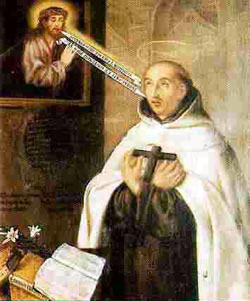
St. John of the Cross is accredited with exploring The Dark Night of the Soul. The use of darkness in his thought represents a type of purity, a sensual finality which the senses cease to engage reality. In his prequel Ascent of Mount Carmel St. John speaks of the movement from meditating on things to the greater goal of spiritual contemplation which does engage objects of imagination. When a person enters into this movement of contemplation the experience will appear to be one of void and obscurity. There is lack of clarity in purity (at least in our experience of it). St. John offers this example to explain.
If we consider a ray of sunlight entering through a window, we see that, the more the said ray is charged with atoms and particles of matter, the more palpable, visible and bright it appears to the eye of sense; yet it is clear that the ray is in itself least pure, clear, simple and perfect at that time, since it is full of so many particles and atoms. And we likewise that, when it is purest and freest from those particles and atoms, the least palpable and the darkest does it appear to the material eye; and the purer it is, the darker and less apprehensible it appears to it. And if the ray were completely pure and free from all these atoms and particles, even from the minutest specks of dust, it would appear completely dark and invisible to the eye, since everything that could be seen would be absent from it - namely the objects of sight. For the eye would find no objects whereon to rest, since light is no proper object of vision.
This reminded me in part of my recent reading of Evagrius of Pontus. Evagrius addresses the demons that attack the soul and manifest themselves in one of the Eight Deadly Thoughts. These demons are not a homogeneous mass of bullies trying to get you to smoke up or trip some old lady. I see them perhaps not unlike the spirit of modern of criticism (give me a minute to unpack this). Modern criticism is relentless in its pursuit of exposure. If there is instability in a given structure then criticism is that tool which will expose it. This too is the swarming of demons who expose the vices of a given subject whether it is through "shameful acts" or the conceit of pride. Listen to how Evagrius describes the work of demons.
The more the soul progresses, the greater are the antagonists that follow it in succession, for I am not convinced that it is always the same demons that persist against it. They know this best who perceive the temptations with greater precision and who see the impassibility they have attained being dislodged by the successive demons.
Impassibility is one of the main goals for the monk. This would in essence reflect a "perfect structure" in which no weakness is exposed. The demons constantly work to dislodge the monk's perceived stability. Perhaps simplistically this reflects a major stream of criticism at least since Descartes. The challenge of course comes in what to do with the exposed weaknesses. I still get the sense that many theorists assume that the work of rigorous criticism is in itself the development of good theory or practice. But here criticism is insatiable and if it is satiated then this likely means that the theory has been stripped of any nutritional value. St. John and Evagrius conceive of another movement. I have normally understood impassibility in a very negative light. To be impassible is to be unfeeling, disengaged staring glassy eyed out into the void. What I am beginning to understand is that these monks do in fact believe that ultimately their bodies are perfect structures. This is not like the theorists hope that criticism will leave that which is pure. The structure rather is pure in its suitability for spirit and love. The demonic, like criticism, reveals where those movements are impeded.
Evagrius again,
Love is the offspring of impassibility, and impassibility is the blossom of the practical life.
I think I should probably end it here for now, this is all getting pretty sketchy. Hopefully something a little more coherent can follow.
Subscribe to:
Posts (Atom)
